

Picture this: You’re a successful real estate investor in Short Pump with a growing portfolio of rental properties across Henrico County. Your credit score is excellent. You have substantial liquid assets in the bank. You’re ready to purchase your next investment property in Glen Allen. But when you apply for a traditional mortgage, you hit a wall—your debt-to-income ratio doesn’t fit the conventional lending box, even though your financial position is rock-solid.
Or maybe you’re a thriving business owner in Chesapeake who reinvests most of your income back into your company. On paper, your tax returns don’t reflect the true strength of your financial situation. Traditional lenders see the numbers and say no, despite your substantial assets and impeccable credit history.
This is where a no ratio mortgage changes everything. These specialized loan products evaluate your financial strength without calculating traditional debt-to-income ratios—opening doors that conventional lenders keep locked. At Low Cost Mortgage, Virginia’s Mortgage Broker of the Year, we connect qualified borrowers with hundreds of lenders offering these income-flexible solutions. Unlike single-lender competitors such as Rocket Mortgage or Freedom Mortgage who are limited to their own product portfolios, our broker model gives you access to specialized financing options that big-name direct lenders simply cannot offer.
How No Ratio Mortgages Work Differently Than Traditional Loans
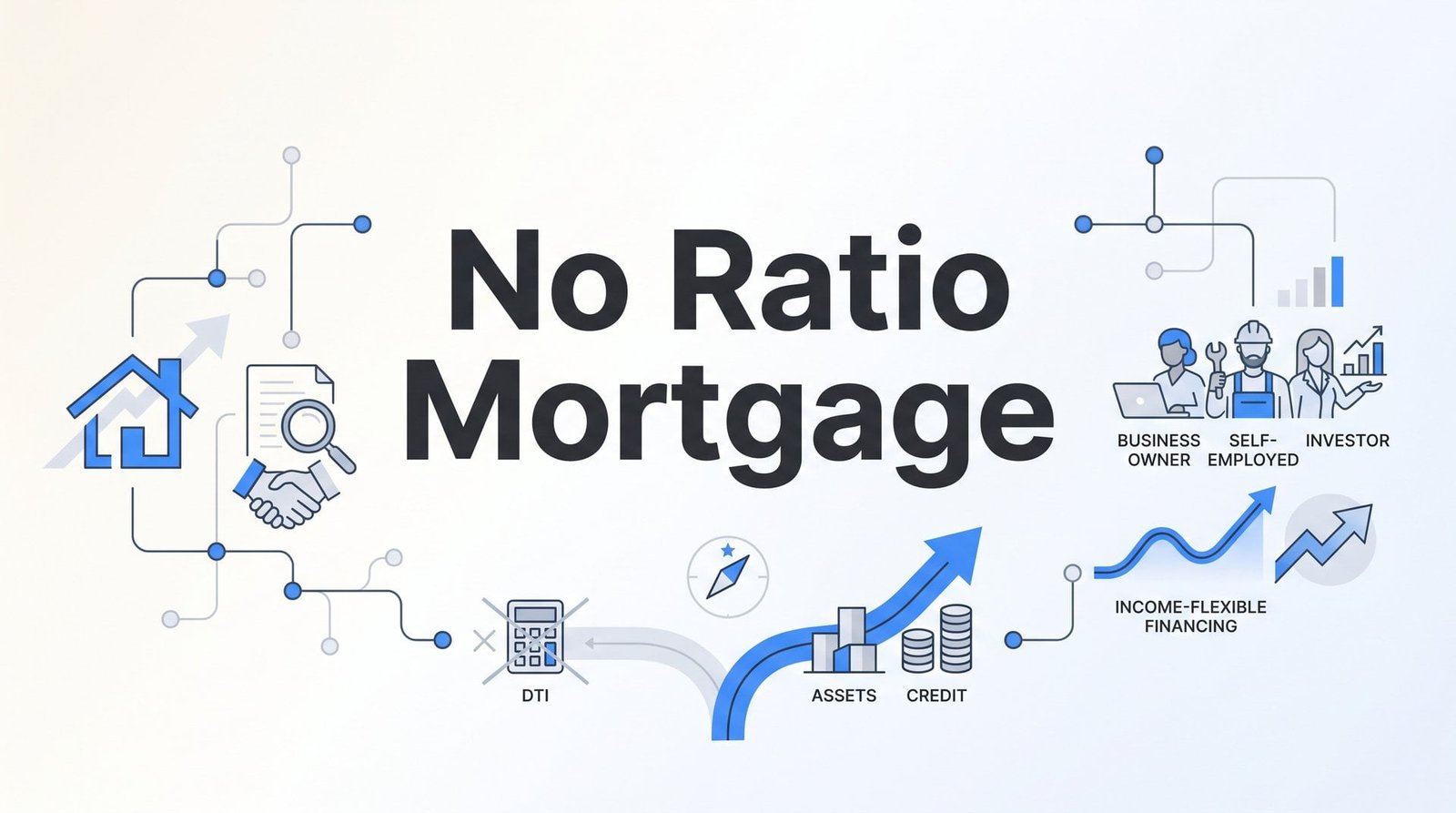
A no ratio mortgage—also called a no-ratio loan or asset-qualifier loan—is a non-QM (non-qualified mortgage) product that approves borrowers without calculating debt-to-income ratios. Instead of focusing on your monthly income versus monthly debts, lenders evaluate your creditworthiness, asset reserves, and down payment capacity.
Think of it like this: Traditional lenders ask “How much do you earn each month?” No ratio lenders ask “How strong is your overall financial position?”
Here’s what makes these loans fundamentally different. Conventional mortgage approval hinges on your DTI ratio—typically requiring that your total monthly debts stay below 43-50% of your gross monthly income. Lenders scrutinize pay stubs, W-2s, tax returns, and employment verification letters. If your income documentation doesn’t fit their formulas, you’re declined—regardless of how much money you have in the bank or how perfect your credit history looks.
No ratio mortgages flip this script entirely. These lenders focus on three core factors: your credit score (demonstrating your history of financial responsibility), your down payment (showing your commitment and reducing lender risk), and your liquid asset reserves (proving you can sustain mortgage payments long-term).
Who benefits most from this approach? Self-employed professionals across Virginia markets—from Richmond attorneys who structure their income through S-corporations to Charlottesville medical practice owners whose tax strategies minimize reported income. Business owners in Hampton Roads whose companies show strong revenue but whose personal tax returns don’t reflect their true earning power. Retirees in Williamsburg and Yorktown living comfortably on investment portfolios rather than traditional pension income. Real estate investors in Midlothian and Chesterfield managing multiple properties whose rental income creates complex tax situations.
The beauty of no ratio mortgages is that they recognize what traditional underwriting often misses: financial strength comes in many forms. A Fredericksburg entrepreneur with $500,000 in liquid assets and a 750 credit score is objectively a strong borrower—even if their tax returns show minimal income due to legitimate business deductions. A Newport News investor with a diversified stock portfolio generating passive income has real financial capacity—even if that income doesn’t appear as traditional W-2 wages.
These loans acknowledge that in 2026’s diverse economy, not everyone’s financial picture fits the conventional employment model. Your ability to repay a mortgage isn’t solely determined by your monthly paycheck—it’s demonstrated by your overall financial strength, credit discipline, and asset position. Understanding what affects mortgage loan interest rates can help you secure the best terms on these specialized products.
Who Qualifies: Requirements for Virginia, Florida, Tennessee, and Georgia Borrowers
No ratio mortgages aren’t for everyone—and that’s intentional. These products serve qualified borrowers with strong financial profiles who simply don’t fit traditional income documentation requirements.
Let’s break down what lenders typically look for. Credit scores usually need to be 680 or higher, with many lenders preferring scores of 700-720+. This isn’t subprime lending—it’s actually serving high-net-worth individuals whose income documentation doesn’t match their financial reality. Your credit history demonstrates your track record of financial responsibility, which becomes even more important when income ratios aren’t part of the equation.
Down payments typically range from 20-30% of the purchase price. A Henrico County homebuyer purchasing a $400,000 property should expect to put down $80,000-$120,000. This substantial equity position protects the lender while demonstrating your financial commitment. The larger down payment also reduces the loan-to-value ratio, which partially offsets the increased risk lenders take by not calculating DTI.
Verified liquid assets are crucial. Lenders want to see reserves covering 6-12 months of mortgage payments in readily accessible accounts. For a $3,000 monthly mortgage payment, that means $18,000-$36,000 in liquid reserves beyond your down payment. These assets prove you can sustain payments even if your income fluctuates—a key consideration when traditional income verification isn’t part of the approval process.
Documentation looks different than conventional loans. Instead of pay stubs and W-2s, you’ll provide bank statements showing asset balances and transaction history. Instead of tax returns proving steady employment income, you’ll verify liquid reserves through investment account statements, retirement account documentation, or business account records. The focus shifts from “prove your monthly income” to “demonstrate your financial strength.”
Market-specific considerations matter across our Virginia service areas. In Richmond’s competitive urban market, strong credit and substantial reserves help you compete with conventional buyers. In growing Spotsylvania and Stafford markets near Fredericksburg, these loans help investors acquire properties quickly without lengthy income documentation delays. In Hampton Roads’ diverse real estate landscape—from Virginia Beach waterfront properties to Chesapeake suburban homes—no ratio mortgages serve everyone from military retirees to successful business owners.
Property type flexibility is another advantage. These loans work for primary residences in Short Pump, second homes near Lake Anna, and investment properties in Ashland or Goochland. Whether you’re purchasing your dream home in Albemarle County or expanding your rental portfolio in Roanoke, exploring our loan programs can help you find the right no ratio financing option.
No Ratio vs. Bank Statement Loans: Choosing the Right Fit
Not all income-flexible mortgages work the same way. Understanding the differences between no ratio mortgages, bank statement loans, and asset-based lending helps you choose the right product for your situation.
Bank statement loans calculate income by analyzing your business or personal bank deposits over 12-24 months. Lenders review your statements, identify qualifying deposits, and use that pattern to establish your monthly income. They then calculate a DTI ratio using this bank-statement-derived income figure. These loans work beautifully for self-employed borrowers who have strong, consistent deposit patterns but whose tax returns don’t reflect their true earning capacity due to business deductions.
No ratio mortgages, by contrast, don’t calculate income at all. They skip the DTI calculation entirely and approve based on assets, credit, and down payment. This makes them ideal when your income is genuinely difficult to document—perhaps you’re transitioning between careers, living on investment returns, or your income varies dramatically month-to-month.
Asset-based loans (sometimes called asset depletion loans) take a different approach. They divide your total liquid assets by a set number (often 360 months) to create a theoretical monthly income figure, then use that to calculate DTI. If you have $1.8 million in verified assets, dividing by 360 gives you $5,000 in theoretical monthly income for qualification purposes.
So when does each option make sense? Consider a Lynchburg business owner with strong, consistent bank deposits but aggressive tax deductions—a bank statement loan likely offers the best rates and terms. A Caroline County retiree with substantial investment accounts but minimal monthly income? Asset-based lending or no ratio mortgages provide the cleanest path. A Prince William County real estate investor with multiple income streams creating complex documentation? No ratio financing eliminates the paperwork maze entirely.
Here’s where Low Cost Mortgage’s broker advantage becomes crystal clear. When you work with Rocket Mortgage, Movement Mortgage, or Veterans United, you get access to their products—period. If they don’t offer the specific non-QM product that fits your situation, you’re out of luck. Our access to hundreds of lenders means we can compare bank statement programs from Lender A, no ratio products from Lender B, and asset-based options from Lender C—then recommend the solution that truly fits your financial profile and goals.
This isn’t just about having options. It’s about expertise in matching borrowers with the right products. A mortgage broker who specializes in non-QM lending understands the nuances between these programs and can guide you toward the most advantageous solution for your specific situation—something a one-size-fits-all direct lender simply cannot provide. Our complete guide to affordable home financing explores these options in greater detail.
Why Virginia Borrowers Choose Low Cost Mortgage Over Big-Name Lenders
Let’s address the elephant in the room: Why work with a mortgage broker instead of going directly to a household name like Rocket Mortgage, PrimeLending, or Fairway Independent Mortgage?
The fundamental difference comes down to business models. Direct lenders like Freedom Mortgage, Penny Mac, or UWM offer their own loan products. They’re essentially selling you from their inventory. Mortgage brokers like Low Cost Mortgage work with hundreds of lenders, comparing products across the market to find the best fit for your specific needs. It’s the difference between shopping at one store versus having a personal shopper who knows every store in the mall.
This distinction becomes critical for specialized products like no ratio mortgages. Many large direct lenders focus primarily on conventional conforming loans and government-backed products (FHA, VA, USDA) because those represent the bulk of the market. Non-QM products like no ratio mortgages? Often not in their wheelhouse at all. When you call Rocket Mortgage asking about no ratio financing, there’s a good chance they’ll tell you it’s not available—not because it doesn’t exist, but because they don’t offer it.
At Low Cost Mortgage, we’ve built relationships with lenders who specialize in these exact products. Our network includes non-QM specialists, portfolio lenders, and alternative financing sources that direct lenders don’t compete with. We know which lenders offer the most competitive no ratio terms, which ones have the smoothest underwriting processes, and which programs work best for different borrower profiles across Virginia, Florida, Tennessee, and Georgia.
But here’s where we really differentiate ourselves: our NoTouch Credit Solutions. Before you formally apply, we can pre-qualify you without pulling your credit—meaning zero impact on your credit score. Compare that to competitors like Atlantic Bay Mortgage, Guild Mortgage, or C&F Mortgage Corporation, where even preliminary conversations often trigger hard credit inquiries that ding your score.
Why does this matter? If you’re exploring multiple financing options or comparing different loan products, each credit pull can lower your score by several points. Our free, no-credit-impact pre-qualification lets you understand your options and explore possibilities without any downside. Once you’ve decided to move forward, we pull credit just once for the formal application. If your credit needs improvement before applying, our credit restoration services can help you qualify for better rates.
Local expertise makes a tangible difference too. When you call a national lender’s 1-800 number, you’re speaking with someone in a call center who may never have set foot in Virginia. They don’t know that Short Pump real estate moves differently than Roanoke properties. They’re not familiar with Chesterfield County’s specific market dynamics or how Fredericksburg’s growth patterns affect property values. They can’t speak knowledgeably about Hampton Roads’ unique military-influenced market or Charlottesville’s university-driven real estate landscape.
Our team understands Virginia markets intimately because we live and work here. We know which lenders are most aggressive in different price ranges across Richmond metro. We understand the documentation nuances for Henrico County investment properties versus Albemarle County primary residences. We can guide you through market-specific considerations that out-of-state lenders simply miss.
As Virginia’s Mortgage Broker of the Year, we’ve earned that recognition by delivering results for borrowers whose needs extend beyond cookie-cutter conventional loans. Our access to hundreds of lenders isn’t just a number—it’s the practical ability to solve financing challenges that single-lender competitors cannot address.
Common Questions: No Ratio Mortgages Answered
Are interest rates higher on no ratio mortgages compared to conventional loans?
Yes, typically. No ratio mortgages generally carry interest rates 1-3 percentage points higher than conventional conforming loans. This reflects the increased risk lenders take by not calculating debt-to-income ratios. However, the rate premium varies significantly based on your credit score, down payment size, and asset reserves. A borrower with a 760 credit score, 30% down payment, and substantial liquid assets will secure much better rates than someone with minimum qualifications. The trade-off is access—if you can’t qualify for conventional financing at all, a slightly higher rate on a no ratio mortgage is still the path to homeownership or investment property acquisition.
What’s the minimum down payment required?
Most no ratio mortgage programs require 20-30% down, though some lenders may go as low as 15% for exceptionally qualified borrowers with very high credit scores and substantial reserves. The down payment serves multiple purposes: it reduces the loan-to-value ratio (protecting the lender), demonstrates your financial commitment, and partially offsets the risk of approving without income documentation. For a $350,000 home in Midlothian, plan on $70,000-$105,000 down.
Can I use a no ratio mortgage for investment properties?
Absolutely. In fact, real estate investors are among the most common users of no ratio mortgages. If you’re building a rental portfolio across Virginia Beach, Chesapeake, and Suffolk, traditional lenders often cap how many financed properties you can have (typically 4-10). No ratio lenders may have more flexible property count limits. Additionally, rental income documentation becomes complex with multiple properties—no ratio financing sidesteps that entire challenge by not calculating income at all.
Are no ratio mortgages considered subprime lending?
This is a critical misconception to address. No ratio mortgages are not subprime products. Subprime lending serves borrowers with poor credit and limited financial resources. No ratio mortgages typically serve high-net-worth individuals with excellent credit who simply don’t fit traditional income documentation boxes. A Louisa County business owner with a 740 credit score, $400,000 in liquid assets, and $120,000 down payment is the opposite of a subprime borrower—they’re simply someone whose financial strength doesn’t show up on traditional pay stubs.
How does the application process differ from traditional mortgages?
The timeline is often similar—30-45 days from application to closing—but the documentation focus shifts dramatically. You won’t provide pay stubs, W-2s, or employment verification letters. Instead, you’ll submit bank statements covering several months, investment account statements, retirement account documentation, and credit reports. Underwriters focus on verifying your assets and reserves rather than calculating income ratios. The process can actually be simpler for self-employed borrowers who find traditional income documentation burdensome.
Will I need to provide tax returns?
This varies by lender and program. Some no ratio products truly require zero income documentation—no tax returns whatsoever. Others may request returns for informational purposes but won’t use them to calculate qualifying income. The specific requirements depend on the lender’s program guidelines and your overall financial profile. This is another area where working with a broker provides advantage—we know which lenders have the most streamlined documentation requirements for your situation. You can contact us to discuss which documentation approach works best for your circumstances.
Your Next Steps: Getting Pre-Qualified in Virginia
Ready to explore whether a no ratio mortgage fits your financial situation? Here’s exactly how the process works with Low Cost Mortgage.
Step One: Initial Consultation
Start with a conversation about your goals and financial position. Are you purchasing a primary residence in Hanover County? Acquiring an investment property in Stafford? Refinancing a current mortgage where traditional income documentation has become challenging? We’ll discuss your credit profile, available down payment, liquid assets, and property objectives. This consultation is free, pressure-free, and designed to determine whether no ratio financing makes sense for your situation.
Step Two: NoTouch Credit Pre-Qualification
Unlike competitors like NFMLending, Embrace Home Loans, or CrossCountry Mortgage who may pull your credit immediately, we utilize our NoTouch Credit Solutions to pre-qualify you without any credit inquiry. You’ll provide basic information about your assets and credit profile, and we’ll give you a realistic assessment of your financing options—with zero impact on your credit score. This lets you explore possibilities and make informed decisions before committing to a formal application.
Step Three: Asset Documentation Preparation
If no ratio financing looks like the right fit, we’ll outline exactly what documentation you’ll need. Typically this includes recent bank statements (usually 2-3 months), investment account statements showing liquid assets, and documentation of your down payment source. We’ll provide a clear checklist so you know exactly what to gather—no surprises, no endless requests for additional paperwork.
Step Four: Lender Matching and Comparison
Here’s where our broker advantage delivers real value. We’ll compare no ratio programs across our network of hundreds of lenders, identifying which ones offer the best rates, terms, and qualification requirements for your specific profile. A Glen Allen investor with substantial reserves might get better terms from Lender A, while a Richmond business owner with different asset positioning might benefit from Lender B’s program. We do the comparison shopping so you get the optimal solution.
Step Five: Formal Application and Underwriting
Once you’ve selected the best program, we submit your formal application and guide you through underwriting. We’ll coordinate asset verification, answer underwriter questions, and keep your transaction moving smoothly toward closing. Our experience with non-QM products means we anticipate potential issues before they become problems. Working with trusted realtors in your area can further streamline the home buying process.
What to Prepare Before Your Consultation
Come ready to discuss your asset position honestly. How much do you have in liquid reserves? What down payment are you comfortable making? What’s your approximate credit score range? What are your property goals—purchase price range, location preferences, timeline? The more specific information you can share, the more precisely we can match you with the right financing solution.
Also consider your broader financial strategy. Are you optimizing for the lowest possible rate, or is flexibility and speed more important? Are you planning to hold the property long-term or is this a shorter-term investment? Your answers help us recommend not just any no ratio mortgage, but the right no ratio mortgage for your specific situation and goals.
Putting It All Together
No ratio mortgages open doors that traditional lending keeps locked. For qualified borrowers across Virginia, Florida, Tennessee, and Georgia whose financial strength doesn’t fit conventional income documentation boxes, these specialized products provide a legitimate path to homeownership and real estate investment.
The key is working with a mortgage partner who truly understands these products and has access to lenders who offer them. That’s where Low Cost Mortgage’s position as Virginia’s Mortgage Broker of the Year creates tangible advantages. When you work with direct lenders like Rocket Mortgage, Southern Trust Mortgage, or RatePro Mortgage, you’re limited to their specific product offerings. If they don’t have a no ratio program—or if their program isn’t competitive—you’re stuck.
Our access to hundreds of lenders means we can find no ratio products that single-lender competitors simply cannot offer. We can compare terms across multiple non-QM specialists, identify the most competitive rates for your profile, and match you with lenders whose underwriting approach aligns with your documentation reality. It’s not just about having options—it’s about having expertise in navigating those options to find your optimal solution.
Our NoTouch Credit Solutions eliminate the risk of exploring your options. Unlike competitors like Alcova Mortgage, Prosperity Mortgage, or CapCenter who may pull hard credit inquiries during preliminary conversations, we pre-qualify you with zero credit impact. You can explore whether no ratio financing fits your situation without any downside—a risk-free way to understand your possibilities before committing to anything.
Local expertise matters when you’re making one of the biggest financial decisions of your life. Our team understands Virginia markets from Short Pump to Virginia Beach, from Fredericksburg to Lynchburg. We know how different property types and locations affect financing options. We can guide you through market-specific considerations that out-of-state call centers simply miss.
Whether you’re a self-employed professional in Richmond whose tax returns don’t reflect your true financial strength, a Chesapeake business owner with substantial assets but complex income documentation, a retiree in Williamsburg living comfortably on investment portfolios, or a real estate investor in Henrico County building a rental portfolio—no ratio mortgages might be exactly what you need.
The question isn’t whether you can qualify for traditional financing. The question is whether there’s a better path that recognizes your actual financial strength rather than forcing you into documentation boxes that don’t fit your reality. For many successful Virginians, no ratio mortgages provide that better path.
Ready to explore your options? Take advantage of our free NoTouch Credit pre-qualification to understand whether no ratio financing makes sense for your situation. No credit impact, no pressure, no obligation—just honest expertise from Virginia’s Mortgage Broker of the Year backed by access to hundreds of lenders. Learn more about our services and discover how income-flexible financing can open doors you thought were closed.