
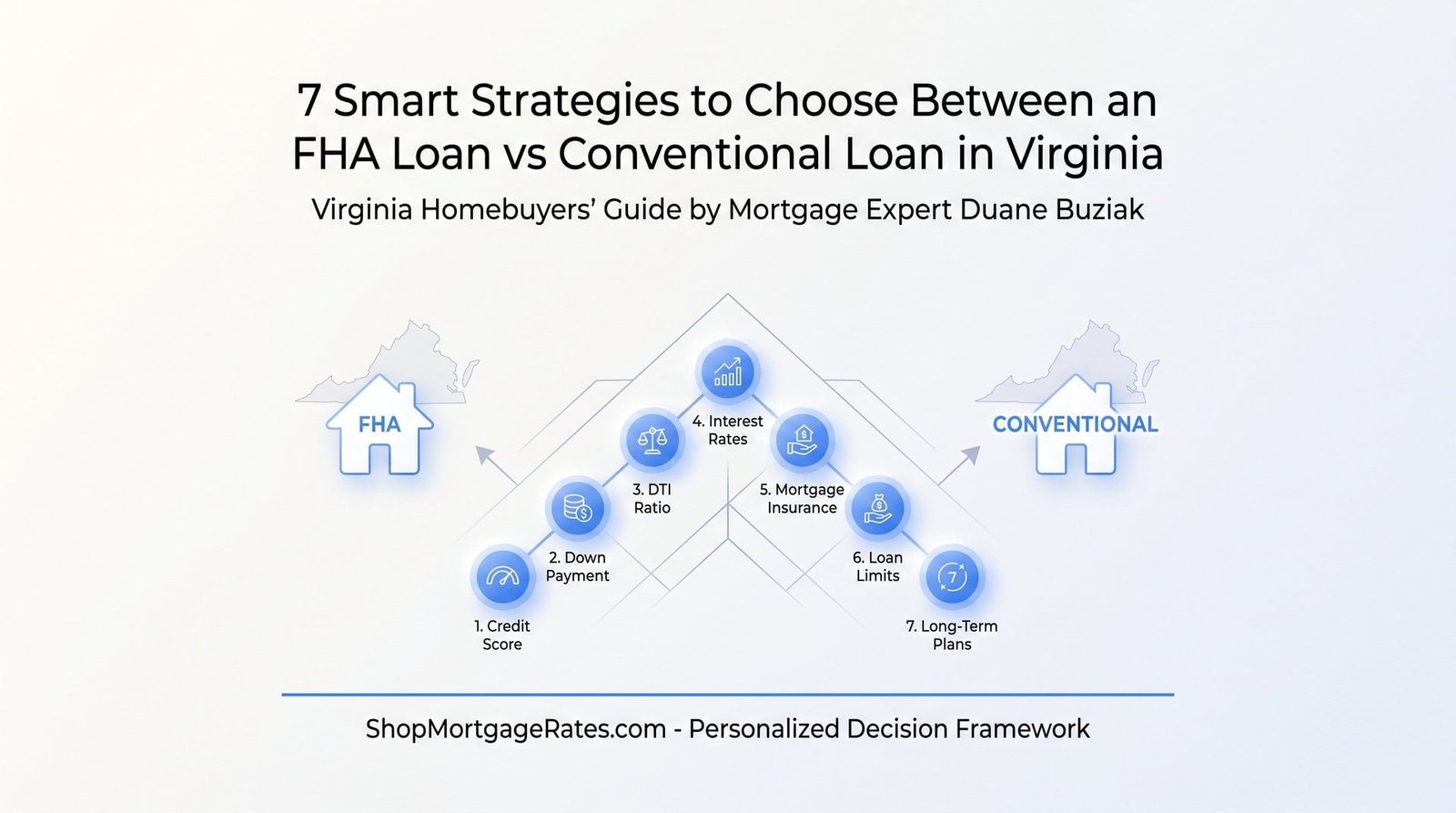

Choosing between an FHA loan and a conventional loan is one of the most consequential decisions Virginia homebuyers face. The wrong pick can cost thousands over the life of your mortgage, and the right answer isn’t the same for everyone. It depends on your credit score, your available down payment, your debt-to-income ratio, and how long you plan to stay in the home.
Whether you’re buying your first home in Richmond, upgrading in Chesapeake, or refinancing in Fredericksburg, the FHA-vs-conventional question deserves a rigorous, data-driven answer. Not a guess. Not a gut feeling.
This guide walks you through seven practical strategies to make the right call. Each one includes comparison tables, worked breakeven math, and concrete implementation steps. By the end, you’ll have a clear decision framework built around your specific financial profile.
Author: Duane Buziak, Mortgage Maestro, NMLS #1110647 | ShopMortgageRates.com
1. Map Your Credit Score to the Right Loan Type
The Challenge It Solves
Your credit score is the single fastest filter for determining which loan type is even available to you, and which one will cost less once you qualify. Many Virginia borrowers assume FHA is always the better deal for first-time buyers. That’s not accurate. The right answer depends entirely on where your score lands.
The Strategy Explained
FHA loans are backed by the Department of Housing and Urban Development. Per HUD guidelines, borrowers with a 580 credit score or higher can qualify with as little as 3.5% down. Borrowers between 500 and 579 can still qualify, but must put 10% down. Conventional loans, governed by Fannie Mae’s Selling Guide, typically require a minimum score of 620.
Here’s where it gets interesting: once your score climbs above 680, conventional loans often win on total cost because PMI rates drop significantly and you avoid FHA’s lifetime mortgage insurance requirement entirely. The crossover point matters enormously. You can learn more about how to check mortgage eligibility without impacting your credit before committing to either path.
Credit Score vs. Loan Type Guidance Table
Score Range | FHA Availability | Conventional Availability | General Cost Advantage
500–579 | Yes (10% down required) | No | FHA only option
580–619 | Yes (3.5% down) | Generally no | FHA only option
620–659 | Yes | Yes | FHA often cheaper (lower PMI equivalent)
660–679 | Yes | Yes | Competitive — run both scenarios
680–719 | Yes | Yes | Conventional often cheaper overall
720+ | Yes | Yes | Conventional typically wins on total cost
Source: HUD FHA Handbook 4000.1; Fannie Mae Selling Guide B3-5.1-01
Implementation Steps
1. Pull your actual credit scores from all three bureaus before starting your mortgage search. Use a soft-pull service that does not impact your credit score.
2. Identify which score bracket you fall into using the table above. If you’re near a threshold (say, 618 or 677), ask a mortgage professional whether a rapid rescore could push you into a more favorable tier before you apply.
3. If your score is above 680, request Loan Estimates for both loan types from multiple lenders. Don’t assume — verify with real numbers.
Pro Tips
At ShopMortgageRates.com, the NoTouch Credit pre-qualification process uses a Vantage Score 4.0 soft pull with no credit impact. This lets you explore your options across hundreds of lenders before committing to a hard inquiry. For Virginia borrowers near a credit score threshold, a soft credit pull mortgage approach can be the difference between guessing and knowing.
2. Run the Down Payment Breakeven Math
The Challenge It Solves
Most buyers focus on the down payment percentage and miss the bigger picture: the total cash-to-close and the ongoing monthly cost differences between FHA and conventional. FHA’s 3.5% minimum sounds attractive, but the upfront mortgage insurance premium adds a meaningful cost that many buyers overlook entirely.
The Strategy Explained
FHA charges an upfront mortgage insurance premium of 1.75% of the loan amount, per HUD Mortgagee Letter 2023-05. This can be rolled into the loan, but it increases your balance and your interest cost over time. Conventional loans have no upfront MIP equivalent. Their PMI is purely a monthly cost that cancels once you reach 80% LTV. For a deeper dive into how much you actually need upfront, see our guide on mortgage down payment requirements in Virginia.
Let’s work through a real example using a hypothetical but realistic Virginia purchase scenario.
Hypothetical Example: $350,000 Home Purchase in Chesterfield County, Virginia
Cost Category | FHA (3.5% Down) | Conventional (5% Down) | Conventional (10% Down)
Down Payment | $12,250 | $17,500 | $35,000
Loan Amount | $337,750 | $332,500 | $315,000
Upfront MIP (1.75%) | $5,911 (financed) | $0 | $0
Financed Loan Balance | $343,661 | $332,500 | $315,000
Est. Monthly P&I (7.00%) | ~$2,286 | ~$2,212 | ~$2,096
Monthly MIP/PMI (est.) | ~$157/mo (0.55% annual) | ~$166/mo (est.) | ~$79/mo (est.)
Total Monthly PITI (excl. taxes/insurance) | ~$2,443 | ~$2,378 | ~$2,175
Note: These figures are hypothetical and for illustrative purposes only. Actual rates, PMI costs, and closing costs vary by lender, credit profile, and market conditions. Interest rate assumed at 7.00% for comparison purposes only. Consult a licensed mortgage professional for your actual numbers.
Implementation Steps
1. Calculate your actual available cash-to-close, including reserves. Many Virginia lenders require 2 months of mortgage payments in reserves after closing.
2. Add the FHA upfront MIP to your true cost comparison, whether financed or paid at closing. Do not ignore it.
3. Compare total monthly payments side by side. A slightly higher down payment on a conventional loan may produce a lower monthly cost and a lower total loan balance.
Pro Tips
The upfront MIP on FHA loans is often the hidden cost that tips the math toward conventional for buyers who can stretch to 5% down. Run both scenarios before deciding. ShopMortgageRates.com can generate side-by-side Loan Estimates across multiple lenders so you see real numbers, not estimates built on assumptions.
3. Compare Total Mortgage Insurance Costs Over Your Planned Timeline
The Challenge It Solves
Monthly mortgage insurance costs are only meaningful when viewed over your actual planned ownership timeline. A buyer who plans to sell in three years faces a completely different calculation than someone planning to stay fifteen years. FHA’s lifetime MIP requirement makes this analysis essential.
The Strategy Explained
Per HUD Mortgagee Letter 2023-05, FHA annual MIP for most 30-year loans with an LTV above 90% is 0.55% of the loan balance. Critically, this MIP does not automatically cancel on loans originated after June 3, 2013, with less than 10% down. It lasts the life of the loan unless you refinance into a conventional mortgage.
Conventional PMI, by contrast, is governed by the Homeowners Protection Act of 1998. It automatically cancels when your loan balance reaches 78% of the original purchase price, and you can request cancellation at 80% LTV with a good payment history. Using a mortgage payment calculator can help you model these scenarios against your specific timeline.
Breakeven Math: When Does Conventional PMI Become Cheaper Than FHA MIP?
Using the same hypothetical $350,000 Chesterfield purchase from Strategy 2:
Year | Cumulative FHA MIP Paid | Cumulative Conv. PMI Paid | Difference
Year 1 | ~$1,884 | ~$1,992 | FHA cheaper by ~$108
Year 3 | ~$5,580 | ~$5,808 | FHA cheaper by ~$228
Year 5 | ~$9,180 | ~$9,120 | Near breakeven
Year 7 | ~$12,684 | ~$7,920 (PMI cancels ~yr 8) | Conventional catching up
Year 10 | ~$18,120 | ~$9,920 (PMI cancelled) | Conventional wins significantly
Year 15 | ~$27,000 | ~$9,920 (no change) | Conventional wins by ~$17,000+
Note: These figures are hypothetical and illustrative only. Actual MIP and PMI amounts depend on loan balance, LTV, credit score, and lender pricing. PMI cancellation timing depends on amortization schedule and home value changes.
The takeaway is clear: if you plan to stay in the home beyond five to seven years, conventional PMI almost always produces lower total mortgage insurance costs, assuming you qualify.
Implementation Steps
1. Define your realistic ownership timeline honestly. First-time buyers in Virginia often stay 5 to 8 years before upgrading or relocating.
2. Ask your lender to produce a full amortization schedule showing when PMI cancels on a conventional loan at your specific LTV and credit score.
3. Compare cumulative MIP vs. cumulative PMI at your planned exit point. This single calculation often determines the better loan type.
Pro Tips
If FHA is your only option today but you plan to stay long-term, build a refinance exit strategy from day one. Strategy 7 covers this in detail. Knowing your breakeven year before you close gives you a concrete target for when to refinance out of FHA MIP.
4. Stress-Test Your Debt-to-Income Ratio Both Ways
The Challenge It Solves
Many Virginia borrowers carrying student loans, car payments, or credit card balances find that their debt-to-income ratio is the binding constraint on their mortgage approval, not their credit score or down payment. Knowing the DTI ceiling for each loan type can mean the difference between getting approved and getting denied.
The Strategy Explained
Debt-to-income ratio compares your total monthly debt obligations (including the proposed mortgage payment) to your gross monthly income. FHA’s automated underwriting system, the TOTAL Scorecard, allows DTIs up to 57% with compensating factors. Conventional loans underwritten through Fannie Mae’s Desktop Underwriter allow up to 50% DTI with an automated approval, per Fannie Mae Selling Guide B3-6-02.
That 7-percentage-point gap can be meaningful. On a $6,000 monthly gross income, the difference between 50% and 57% DTI represents $420 per month in additional allowable debt obligations. Understanding the full mortgage approval process can help you prepare for how each loan type evaluates your financial profile.
DTI Comparison Table
Loan Type | Standard DTI Limit | Maximum with Compensating Factors | Source
FHA | 43% (standard) | Up to 57% | HUD TOTAL Scorecard / FHA Handbook 4000.1
Conventional (Fannie Mae) | 45% (standard) | Up to 50% with DU approval | Fannie Mae Selling Guide B3-6-02
Source: HUD FHA Handbook 4000.1; Fannie Mae Selling Guide B3-6-02
Implementation Steps
1. Calculate your current DTI before speaking with any lender. Add all monthly minimum debt payments plus your estimated new mortgage payment (PITI), then divide by your gross monthly income.
2. If your DTI falls between 50% and 57%, FHA may be your only viable path to approval. Confirm this with a licensed mortgage professional who can run your file through both automated systems.
3. If your DTI is below 45%, run both scenarios. A lower DTI often qualifies you for better conventional pricing, which may outweigh FHA’s other advantages.
Pro Tips
Student loan debt is treated differently under FHA and conventional guidelines. FHA uses 0.5% of the outstanding balance as the monthly payment if no payment is listed on the credit report. Fannie Mae uses the actual payment or 1% of the balance. Depending on your student loan balance, this difference alone can shift your DTI by several percentage points. Always confirm how each program treats your specific debts before assuming you know your DTI.
5. Factor in Virginia-Specific Property and Appraisal Requirements
The Challenge It Solves
Virginia’s housing stock is diverse, ranging from newer construction in Henrico and Stafford to historic homes in Fredericksburg, Williamsburg, and older Richmond neighborhoods. FHA’s property condition requirements can create unexpected complications on homes that would sail through a conventional appraisal without issue.
The Strategy Explained
FHA appraisals are governed by HUD Handbook 4000.1, which requires that a property meet minimum property standards covering safety, soundness, and security. FHA appraisers are required to flag issues including peeling paint on pre-1978 homes (lead paint concern), roof conditions with less than two years of remaining life, exposed electrical wiring, broken windows, evidence of water intrusion, and inoperable heating systems.
Conventional appraisals are governed by the Uniform Standards of Professional Appraisal Practice (USPAP) but do not carry HUD-level repair mandates. A conventional appraiser’s primary job is to establish market value. Condition issues are noted, but they rarely become hard stops unless they are severe enough to affect habitability or marketability. Buyers exploring the Fredericksburg home financing market should be especially aware of these differences given the area’s older housing stock.
Property Condition: FHA vs. Conventional Appraisal Requirements
Property Issue | FHA Appraisal | Conventional Appraisal
Peeling paint (pre-1978 home) | Required repair before closing | Noted; not typically required repair
Roof with <2 years remaining life | Required repair or replacement | Noted in report; lender discretion
Exposed electrical wiring | Required repair | Noted; may or may not require repair
Broken windows | Required repair | Noted; typically not a hard stop
Evidence of water intrusion | May require remediation | Noted; value adjustment possible
Inoperable HVAC | Required repair | Noted; lender discretion
Source: HUD Handbook 4000.1, Section II.A.3; USPAP 2024-2025 Edition
Implementation Steps
1. Before making an offer on an older Virginia home, do a visual walk-through with an eye toward FHA-flaggable issues: peeling paint, roof condition, visible plumbing or electrical concerns.
2. If the home has known condition issues, ask your mortgage professional whether a conventional loan would be a cleaner path. A deal that dies on FHA appraisal conditions can often close conventionally.
3. If FHA is your only option and the home has condition issues, negotiate seller concessions to cover required repairs, or request an escrow holdback arrangement where permitted.
Pro Tips
In competitive Virginia markets like Short Pump or Glen Allen, sellers often prefer conventional offers because they carry less appraisal risk. If you’re competing against multiple offers, knowing that your FHA financing introduces appraisal condition risk may influence your offer strategy. A conventional pre-approval can strengthen your position even if FHA would technically cost less.
6. Use the Multi-Lender Shopping Advantage to Compare Real Offers
The Challenge It Solves
Theoretical comparisons between FHA and conventional loans are useful starting points, but they cannot replace actual Loan Estimates from real lenders. Rates, fees, and pricing vary meaningfully across lenders, and the loan type that looks better in a generic comparison may not be the better deal when you factor in a specific lender’s pricing on your specific profile.
The Strategy Explained
The mortgage market in Virginia includes a wide range of lender types: national online direct lenders like Rocket Mortgage, specialty lenders like Veterans United, regional banks, credit unions, and independent mortgage brokers. Each has different pricing structures, overhead costs, and access to capital markets. Our guide on mortgage rate comparison strategies walks through how to evaluate these differences systematically.
Mortgage brokers, by contrast, access multiple wholesale lenders simultaneously. ShopMortgageRates.com shops hundreds of lenders to find competitive pricing on both FHA and conventional products. This is a structural difference, not a marketing claim. A direct lender can only offer its own products at its own pricing. A broker can compare across the market in real time.
Lender Type Comparison: How They Differ
Lender | Type | FHA Available | Conv. Available | Lender Count | Key Differentiator
ShopMortgageRates.com | Mortgage Broker | Yes | Yes | Hundreds | Shops multiple wholesale lenders; NoTouch Credit soft pull
Rocket Mortgage | Direct Online Lender | Yes | Yes | 1 (own products) | Fast digital process; single lender pricing
Movement Mortgage | Direct Lender | Yes | Yes | 1 (own products) | Community-focused; in-house processing
CapCenter | Direct Lender | Yes | Yes | 1 (own products) | Virginia-based; flat-fee closing cost model
Veterans United | Direct Lender | No (VA specialist) | Limited | 1 (own products) | VA loan specialist; less focus on FHA/Conv
PrimeLending | Direct Lender | Yes | Yes | 1 (own products) | National footprint; local loan officers
Guild Mortgage | Direct Lender | Yes | Yes | 1 (own products) | Broad program menu; purchase-focused
Note: Lender capabilities and offerings are subject to change. This table reflects general publicly available information and is provided for educational comparison purposes only. Always verify current offerings directly with each lender.
The critical point: getting a Loan Estimate from only one lender means you have no basis for comparison. The Consumer Financial Protection Bureau (CFPB) consistently recommends getting multiple Loan Estimates to compare total costs, not just the interest rate.
Implementation Steps
1. Request Loan Estimates for both FHA and conventional from at least three lenders. The Loan Estimate is a standardized form (CFPB-mandated) that allows apples-to-apples comparison of rates, fees, and total costs.
2. Compare Section A (origination charges), Section B (services you cannot shop for), and the total cash-to-close on each estimate. Interest rate alone is not the full picture.
3. Use ShopMortgageRates.com’s NoTouch Credit pre-qualification to initiate this process without triggering a hard inquiry. This protects your credit score during the shopping phase.
Pro Tips
When you bring competing Loan Estimates to a lender, you give them the opportunity to sharpen their pricing. This is called rate shopping, and it is one of the most effective cost-reduction strategies available to Virginia homebuyers. The CFPB notes that multiple mortgage inquiries within a short window (typically 14 to 45 days depending on the scoring model) are treated as a single inquiry for credit scoring purposes. Shopping aggressively does not hurt your score when done correctly.
7. Build a Refinance Exit Strategy Before You Close
The Challenge It Solves
For borrowers who must use FHA today due to credit score, down payment, or DTI constraints, the lifetime MIP requirement creates a long-term cost burden that grows every year. Without a plan to exit FHA MIP, many Virginia homeowners find themselves paying mortgage insurance indefinitely on a home that has appreciated well past the point where it’s necessary.
The Strategy Explained
FHA MIP on loans originated after June 3, 2013, with less than 10% down does not cancel automatically. The only way to eliminate it is to refinance into a conventional loan. This makes the refinance exit strategy an integral part of your FHA loan decision, not an afterthought. Our detailed guide on how to refinance your home in Virginia covers the full process from application to closing.
The two conditions that typically enable a successful FHA-to-conventional refinance are: reaching 80% LTV (so you avoid conventional PMI entirely) and improving your credit score to qualify for competitive conventional pricing. Both are achievable with a deliberate plan.
Breakeven Math: FHA-to-Conventional Refinance Planning
Hypothetical scenario: $343,661 financed FHA balance (from Strategy 2 example), 7.00% rate, $157/month MIP.
Refinance Trigger | Estimated Timeline | Monthly Savings Potential | Refinance Cost Consideration
Reach 80% LTV (no PMI on refi) | 8–12 years via amortization alone | ~$157/mo MIP eliminated | Closing costs typically 2–3% of new loan
Reach 80% LTV with appreciation | 3–6 years in appreciating market | ~$157/mo MIP eliminated | Closing costs typically 2–3% of new loan
Improve credit score to 740+ | Concurrent goal | Lower rate possible | Stacks with MIP savings
Note: Hypothetical figures for illustration only. Actual timelines depend on appreciation, extra principal payments, and market conditions. Refinance closing costs vary by lender and loan amount.
Refinance Breakeven Calculation (Worked Example):
Assume refinance closing costs of $6,000 on a $310,000 conventional refi. Monthly savings from eliminating FHA MIP: $157/month.
Breakeven = $6,000 ÷ $157 = approximately 38 months (about 3 years and 2 months).
If you plan to stay in the home at least 3 years beyond the refinance date, the refinance pays for itself and then generates ongoing savings for the remainder of your ownership.
Implementation Steps
1. At closing, document your FHA loan origination date, original loan balance, and current LTV. Set a calendar reminder to review refinance eligibility every 12 months.
2. Make on-time payments consistently. Payment history is the largest component of your credit score, and improving your score from 620 to 720+ can meaningfully reduce your conventional rate when you refinance.
3. Monitor your home’s market value annually. In many Virginia markets, appreciation can accelerate your path to 80% LTV faster than amortization alone. A new appraisal showing higher value can support a refinance sooner than your amortization schedule suggests.
Pro Tips
Consider making additional principal payments toward your FHA loan. Even $100 to $200 per month in extra principal can shave months off your path to 80% LTV and bring your refinance exit date forward meaningfully. You may also want to explore low cost refinance options when the time comes to minimize your out-of-pocket expenses on the transition. Run the math with your mortgage professional to find the optimal extra payment amount relative to your refinance savings goal.
Pulling It All Together: Your FHA vs Conventional Decision Framework
Seven strategies, one goal: the right loan for your specific situation. Here’s the condensed decision framework.
Quick Decision Guide:
If your credit score is below 580: FHA with 10% down is likely your only option. Work with a mortgage professional to build a credit improvement plan.
If your credit score is 580–619: FHA at 3.5% down is typically your primary path. Run the MIP breakeven math against your planned ownership timeline.
If your credit score is 620–679: Run both scenarios with real Loan Estimates. FHA may still win on monthly cost, but conventional avoids lifetime MIP.
If your credit score is 680 or above: Conventional often wins on total cost. Verify with actual lender quotes before deciding.
If your DTI exceeds 50%: FHA’s higher DTI ceiling may be your only approval path regardless of credit score.
If you’re buying an older Virginia home: Assess FHA appraisal risk before structuring your offer. Conventional may be a cleaner path to closing.
If you must use FHA today: Build your refinance exit strategy before you close. Know your breakeven year and set a credit score improvement goal.
The most important step is getting real Loan Estimates for both loan types from multiple lenders. Theory is a starting point. Actual numbers are the decision.
Securely pre-qualify in minutes at ShopMortgageRates.com with no credit impact. The NoTouch Credit process uses a soft pull so you can explore your options across hundreds of lenders without a single hard inquiry hitting your report. It’s free, fast, and built for Virginia homebuyers who want real answers before they commit.
Frequently Asked Questions: FHA Loan vs Conventional Loan
Can I switch from an FHA loan to a conventional loan later?
Yes. You can refinance from an FHA loan into a conventional loan at any time, provided you meet the conventional loan’s credit, income, and LTV requirements at the time of refinancing. The most common reason to do this is to eliminate FHA’s lifetime mortgage insurance premium. Many Virginia homeowners target this refinance once their home has appreciated enough to reach 80% LTV and their credit score has improved.
Which loan type has lower closing costs, FHA or conventional?
Closing costs for both loan types are generally comparable in terms of third-party fees (title, appraisal, attorney, recording). The key difference is FHA’s upfront mortgage insurance premium of 1.75% of the loan amount, which can be financed into the loan or paid at closing. If paid at closing, this significantly increases FHA’s total closing cost. Conventional loans have no equivalent upfront MIP charge, though PMI may apply monthly.
Is FHA always the better option for first-time homebuyers?
No. FHA is often the better option for first-time buyers with credit scores below 680 or limited down payment funds, but it is not universally superior. First-time buyers with scores above 680 and at least 5% down should run a full cost comparison, including total MIP vs. PMI costs over their planned ownership timeline. In many cases, conventional produces lower total costs for buyers who qualify.
Does FHA mortgage insurance ever go away?
For FHA loans originated after June 3, 2013, with a down payment below 10%, mortgage insurance premiums do not cancel automatically. They remain for the life of the loan. The only way to eliminate FHA MIP on these loans is to refinance into a conventional mortgage. For FHA loans with 10% or more down, MIP cancels after 11 years. This is a critical distinction when evaluating long-term ownership costs.
How does PMI cancellation work on conventional loans?
Conventional PMI cancellation is governed by the Homeowners Protection Act of 1998. Lenders are required to automatically cancel PMI when your loan balance reaches 78% of the original purchase price, based on your scheduled amortization. You may also request cancellation at 80% LTV with a good payment history and, in some cases, a new appraisal demonstrating sufficient equity. This automatic cancellation feature is one of the primary long-term cost advantages of conventional loans over FHA for borrowers who qualify.
Legal Disclaimer: This article is provided for educational and informational purposes only and does not constitute financial, legal, or tax advice. Mortgage programs, rates, and guidelines are subject to change without notice. All loan scenarios presented are hypothetical and for illustrative purposes only. Actual rates, fees, and loan terms will vary based on individual borrower qualifications, property type, loan amount, and market conditions at the time of application. All loans are subject to underwriting approval. Not all borrowers will qualify. This information applies to residential mortgage lending in Virginia, Florida, Tennessee, and Georgia only. FHA loan guidelines referenced are per HUD Handbook 4000.1 and HUD Mortgagee Letter 2023-05. Conventional loan guidelines referenced are per Fannie Mae Selling Guide. PMI cancellation rights are governed by the Homeowners Protection Act of 1998 (12 U.S.C. § 4901 et seq.). Duane Buziak, Mortgage Maestro, NMLS #1110647. ShopMortgageRates.com. Equal Housing Lender.