

When you search for the lowest rate mortgage providers, the real question isn’t which company advertises the best number. It’s which provider structure is most likely to surface the rate your actual credit profile and loan scenario qualify for. A 0.25% rate difference on a $400,000 loan translates to roughly $57 per month and more than $20,000 across a 30-year term, so the stakes are genuinely significant.
The providers on this list were selected based on structural access to wholesale pricing, loan program depth, LLPA transparency, and the ability to compete on rate across conventional, FHA, VA, and jumbo scenarios. One critical note before you begin: always compare APR alongside the note rate. A low rate paired with high origination fees can cost more over time than a slightly higher rate with little to nothing out of pocket at closing. Use our mortgage shopping tips and mortgage affordability calculator as companion resources while you evaluate.
Inline byline: Duane Buziak, NMLS #1110647, Coast2Coast Mortgage LLC NMLS #376205
Understanding Provider Structure Before You Compare Rates
Not all mortgage providers are built the same, and that structural difference matters more than most borrowers realize. The mortgage market divides into three categories: wholesale brokers, retail direct lenders, and lead-generation aggregators.
Wholesale brokers access rates from hundreds of wholesale lenders simultaneously. Because they operate in the wholesale channel, they can often source lower note rates than a single retail institution’s posted rate card. Retail direct lenders price from their own balance sheet or rate card, meaning you see one institution’s offer, not a competitive market. Lead-gen aggregators collect borrower data and sell leads to lenders — they don’t originate loans, and the rates they display are often teaser rates requiring specific credit and LTV profiles to qualify.
This list features only originating providers: one wholesale broker and a selection of retail direct lenders with distinct program strengths. The CFPB’s mortgage rate exploration tool is a useful neutral reference for understanding how these structures affect pricing.
The Rate vs. Points Math You Need to Know
Before evaluating any provider, it helps to understand the breakeven math on discount points. Here’s a worked example using real amortization calculations on a $400,000 30-year fixed loan.
Scenario A: 6.75% note rate, no discount points. Monthly principal and interest: approximately $2,594.
Scenario B: 6.50% note rate, one discount point ($4,000 paid at closing). Monthly principal and interest: approximately $2,528.
Monthly savings in Scenario B: $66. Breakeven on the $4,000 point cost: $4,000 divided by $66 equals approximately 61 months, or just over five years.
The conclusion is straightforward: if you plan to hold the loan fewer than 61 months, the lower rate via points costs more in total. If you hold longer, you save. This math applies regardless of which provider you choose, and it’s the reason APR comparison matters as much as the note rate itself. The CFPB’s explanation of APR vs. note rate is worth bookmarking before you start collecting quotes.
1. Shop Mortgage Rates
Best for: Borrowers who want wholesale market access, down payment assistance, and no hard inquiry pre-qualification
Shop Mortgage Rates is a wholesale mortgage broker operating under Duane Buziak, NMLS #1110647, Coast2Coast Mortgage LLC NMLS #376205, licensed in Virginia, Florida, Tennessee, and Georgia.

Where This Tool Shines
The structural advantage here is meaningful. As a broker rather than a retail lender, Shop Mortgage Rates shops your loan scenario across hundreds of wholesale lenders simultaneously. You’re not receiving one institution’s rate card — you’re accessing a competitive wholesale market where lenders bid for your business. This is particularly relevant for borrowers whose LLPA profile (credit score, LTV, loan purpose, property type) might land more favorably with one wholesale investor than another.
The no credit impact mortgage pre-qualification is a genuine differentiator. A soft credit pull pre-qualification means you can get a real picture of your rate options without triggering a hard inquiry on your credit report. The CFPB confirms that mortgage rate shopping within a 45-day window counts as a single inquiry for FICO scoring purposes, but starting with a soft pull removes even that concern during early evaluation.
Key Features
Wholesale broker access: Shops your scenario across 500+ wholesale lenders rather than presenting a single institution’s rate shelf.
Soft credit pull pre-qualification: A no hard inquiry mortgage pre-approval option lets you evaluate rate scenarios without any credit score impact.
Dynamo DPA and Turbo DPA: Down payment assistance programs that can reduce or eliminate the upfront cash requirement for eligible borrowers. Note that DPA programs can affect first-mortgage pricing depending on structure — a nuance worth discussing directly with the broker.
90% cash-out refinance: A higher cash-out ceiling than many retail lenders offer on conventional products.
Homes for Heroes: A participating affiliate offering closing cost savings for teachers, firefighters, law enforcement, healthcare workers, and military personnel. See HUD’s homebuying resources for context on assistance programs generally.
Best For
Borrowers in Virginia, Florida, Tennessee, or Georgia who want to access wholesale pricing rather than a single retail rate card. Particularly well-suited for first-time buyers exploring down payment assistance, public service professionals eligible for Homes for Heroes, and homeowners considering a high-LTV cash-out refinance. Also a strong fit for anyone who wants to start the process with a no credit hit mortgage application.
Pricing
No origination fee structure is disclosed publicly. Contact directly for scenario-specific pricing. Licensed in VA, FL, TN, and GA only — not available in all states.
2. Rocket Mortgage
Best for: Borrowers who prefer a fully digital, self-serve application experience
Rocket Mortgage is a retail direct lender and one of the highest-volume mortgage originators in the United States by loan count.
Where This Tool Shines
Rocket’s core strength is its digital infrastructure. The application process is designed to be completed without a loan officer conversation if the borrower prefers that, and the platform’s pre-approval turnaround is among the fastest in the retail channel. For borrowers with straightforward W-2 income, strong credit, and a conventional loan scenario, the automated process can move quickly.
The tradeoff is structural. As a retail lender, Rocket prices from its own rate card. You’re receiving one institution’s offer, not a competitive wholesale market. Borrowers who want to compare Rocket’s rate against a wholesale broker’s pricing should do so before committing, since the rate shelf you see is the rate shelf Rocket has set — not the result of multi-lender competition.
Key Features
Fully digital application: End-to-end online process from application through closing documentation.
Broad product menu: Conventional, FHA, VA, and jumbo loan products available.
Fast pre-approval: Automated underwriting can generate pre-approval decisions quickly for qualifying profiles.
Rate lock at application: Option to lock a rate early in the process, which can be relevant in a volatile rate environment.
Customer service infrastructure: Large support team with extended availability, relevant for borrowers who want responsive communication.
Best For
Borrowers with clean, documentable income and strong credit who value speed and digital convenience over multi-lender rate competition. Less optimal for borrowers with complex income documentation, non-traditional credit profiles, or those seeking wholesale pricing.
Pricing
Rates vary by borrower profile; origination fees apply. Check rocketmortgage.com for current disclosures.
3. Guild Mortgage
Best for: Borrowers with non-traditional credit profiles or first-time buyers needing program depth
Guild Mortgage is a retail mortgage lender with a program portfolio that extends well beyond conventional conforming loans.
Where This Tool Shines
Guild’s differentiator is program breadth. Where many retail lenders focus on conventional and FHA volume, Guild has built infrastructure around USDA loans, specialty first-time homebuyer programs, and borrowers with non-traditional credit histories or thinner files. If your credit profile doesn’t fit neatly into a standard LLPA grid, Guild is worth evaluating because their underwriting team has experience with edge cases that automated retail platforms often decline.
Guild also maintains a branch network with in-person loan officer access, which matters for borrowers who want human guidance through a complex transaction. The combination of program depth and loan officer availability makes Guild a reasonable option for purchase transactions involving multiple assistance layers.
Key Features
Broad loan program menu: Conventional, FHA, VA, USDA, and jumbo products under one roof.
Non-traditional credit underwriting: Capacity to work with borrowers who lack a deep traditional credit file.
First-time homebuyer programs: Specialty products designed for buyers entering the market for the first time.
In-person branch access: Physical loan officer presence in select markets for face-to-face guidance.
DPA partnerships: Down payment assistance program relationships in select markets.
Best For
First-time buyers, borrowers with thin credit files, and those seeking USDA financing in eligible rural areas. Also a reasonable option for buyers in markets where Guild has a local branch presence and in-person guidance adds value.
Pricing
Rates and fees vary by loan type and borrower profile. Check guildmortgage.com for current disclosures.
4. Movement Mortgage
Best for: Purchase borrowers in competitive markets where fast closing timelines matter
Movement Mortgage is a retail mortgage lender known for its rapid underwriting model and community-mission lending approach.
Where This Tool Shines
Movement’s primary differentiator is speed. The company has built its operational model around fast underwriting and quick closing timelines, which is a genuine competitive advantage in purchase markets where sellers are evaluating multiple offers. A pre-approved buyer with a lender known for reliable, fast closings can carry more credibility with a seller than a buyer whose financing timeline is uncertain.
The community-mission component is notable for borrowers who factor values into their financial decisions: Movement directs a significant portion of profits toward charitable causes. This doesn’t affect rate or underwriting, but it’s a differentiator that resonates with certain borrowers.
Key Features
Rapid underwriting model: Designed for fast closing timelines, relevant in competitive purchase markets.
Full government loan menu: Conventional, FHA, VA, and USDA products available.
Community-mission model: Profits directed to charitable causes as a core business commitment.
Local loan officer network: In-market loan officers in many geographies for relationship-based service.
Purchase-focused operations: Operational infrastructure built around purchase transactions rather than refinance volume.
Best For
Purchase borrowers in competitive real estate markets where closing speed and lender reliability matter to sellers. Also worth considering for borrowers who value a mission-driven lending institution alongside competitive rate options.
Pricing
Rates and origination fees vary. Check movement.com for current rate disclosures.
5. Embrace Home Loans
Best for: Borrowers who want personalized loan officer guidance without a fully automated experience
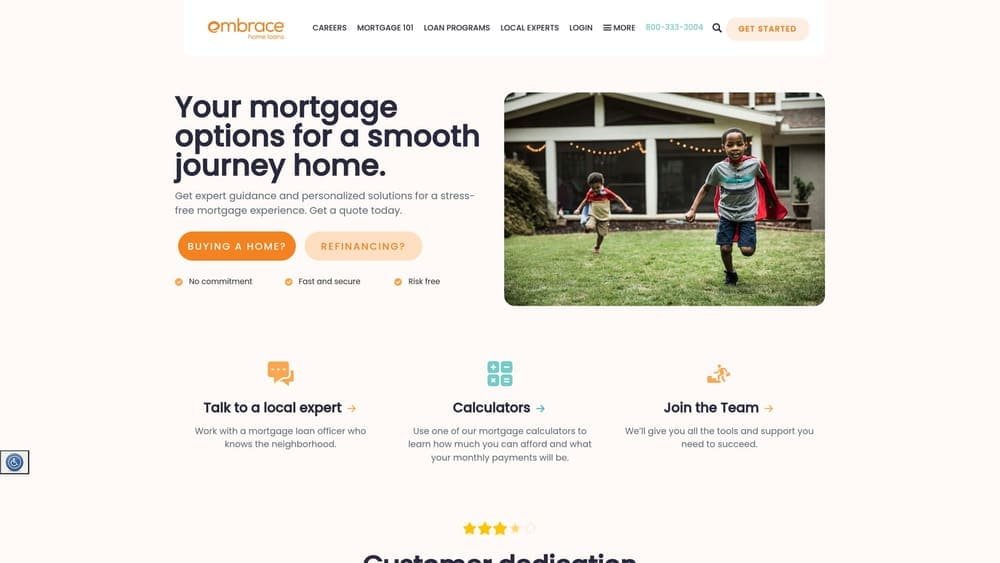
Embrace Home Loans is a retail and correspondent mortgage lender with a service model centered on human guidance through the loan process.
Where This Tool Shines
Embrace operates in both retail and correspondent lending channels, which gives it some pricing flexibility compared to a pure retail lender. The correspondent channel allows Embrace to close loans in its own name and then sell them to investors, which can sometimes translate to more competitive pricing than a standard retail rate card.
The service model emphasis is the clearest differentiator. Where fully automated platforms are designed to minimize human touchpoints, Embrace explicitly builds loan officer relationships into the process. For borrowers navigating a first purchase, a complex refinance, or a scenario with documentation nuances, that human follow-through can reduce errors and improve the overall experience.
Key Features
Retail and correspondent channels: Dual-channel structure provides some pricing flexibility beyond a standard retail rate shelf.
Personalized loan officer model: Emphasis on relationship-based guidance rather than fully automated processing.
Online application with human follow-through: Digital intake paired with loan officer involvement throughout the process.
Purchase and refinance options: Capacity across both transaction types without a singular focus on one.
Best For
Borrowers who want a digitally accessible application process without sacrificing human guidance. Particularly relevant for first-time buyers, borrowers with documentation complexity, or anyone who finds fully automated platforms impersonal or difficult to navigate.
Pricing
Rates and fees vary by loan scenario. Check embracehomeloans.com for current disclosures.
6. Veterans United Home Loans
Best for: VA-eligible borrowers seeking the deepest institutional expertise in VA loan underwriting
Veterans United Home Loans is the highest-volume VA loan originator in the country by unit count, per publicly available VA lender statistics at benefits.va.gov.
Where This Tool Shines
Veterans United’s singular focus on VA-eligible borrowers creates institutional depth that general-purpose lenders typically can’t match. VA loan underwriting has specific nuances: the VA Funding Fee structure, entitlement restoration for borrowers with prior VA loans, second-tier entitlement scenarios, and the absence of a conventional LLPA grid (which the VA Funding Fee framework replaces). Loan officers at Veterans United handle these scenarios routinely, which reduces the risk of errors that can delay or derail a VA transaction.
The VA loan’s structural advantages — no private mortgage insurance requirement, no down payment requirement for eligible borrowers, and competitive rate access — are best realized when the originator understands the product deeply. Volume leadership in the VA channel is a reasonable proxy for that depth.
Key Features
Highest VA loan volume nationally: Leading originator by unit count per VA lender statistics — a proxy for VA-specific underwriting depth.
VA-specific expertise: Deep institutional knowledge of VA Funding Fee structure, entitlement restoration, and second-tier entitlement scenarios.
Pre-purchase counseling: VA loan education resources designed to prepare borrowers before application.
Conventional options available: Non-VA loan products for eligible borrowers whose scenario benefits from conventional financing.
Entitlement restoration support: Specialized capacity for borrowers with prior VA loans seeking to restore or layer entitlement.
Best For
Active duty service members, veterans, and surviving spouses who want the deepest available institutional expertise in VA loan origination. Particularly valuable for borrowers navigating entitlement restoration, second-tier entitlement, or a VA loan scenario with complexity that a general-purpose retail lender may not handle efficiently.
Pricing
VA loans carry no private mortgage insurance but include a VA Funding Fee, which is waived for eligible disabled veterans. Check veteransunited.com for current rate disclosures.
Frequently Asked Questions
What’s the difference between a mortgage note rate and APR?
The note rate is the interest rate applied to your loan balance each month. APR is the annualized cost of the loan including fees such as origination charges, discount points, and certain closing costs. A lender advertising a lower note rate with high fees may carry a higher APR than a lender quoting a slightly higher rate with little to nothing out of pocket at closing. The CFPB’s APR explainer covers this clearly.
How do loan-level price adjustments (LLPAs) affect my mortgage rate?
LLPAs are risk-based pricing grids published by Fannie Mae and Freddie Mac. They adjust the cost of a conventional loan based on credit score, loan-to-value ratio, loan purpose, and property type. A borrower with a 680 FICO at 80% LTV receives a materially different LLPA than a 760 FICO borrower at the same LTV. The current Fannie Mae LLPA matrix is publicly available. Wholesale brokers can sometimes find investors with more favorable LLPA overlays — retail lenders apply a single grid.
Can I shop multiple mortgage lenders without hurting my credit score?
Yes. The CFPB confirms that mortgage rate shopping within a 45-day window counts as a single inquiry for FICO scoring purposes. Additionally, a soft pull mortgage broker pre-qualification — like the one offered by Shop Mortgage Rates — allows you to evaluate rate scenarios without any hard inquiry at all. See the CFPB’s credit shopping guidance for details.
Is a mortgage broker or a direct lender more likely to offer the lowest rate?
Structurally, a wholesale broker has access to a competitive market of hundreds of wholesale lenders rather than a single institution’s rate card. This doesn’t guarantee the lowest rate in every scenario, but it does mean the broker’s pricing reflects competition rather than a single shelf. For borrowers whose LLPA profile varies significantly across investors, the broker channel is often where the most favorable pricing surfaces.
What does it mean to buy down a mortgage rate with discount points — and is it worth it?
One discount point equals 1% of the loan amount paid at closing in exchange for a lower note rate. Using the worked example above: on a $400,000 loan, one point ($4,000) buying a rate from 6.75% to 6.50% saves $66 per month, with a breakeven of approximately 61 months. If you hold the loan longer than five years, you come out ahead. If you sell or refinance sooner, the points cost more than they save.
How does my credit score affect the rate I’m quoted?
Credit score is one of the primary inputs in the LLPA grid for conventional loans. Higher scores receive lower LLPA charges, which translates to lower rates or lower fees. The difference between a 680 and a 760 FICO can represent a meaningful pricing gap. Fannie Mae and Freddie Mac have also approved a transition to VantageScore 4.0 alongside FICO 10T for GSE loan delivery, which can benefit thin-file borrowers who previously lacked a scoreable traditional FICO.
Does using a down payment assistance program affect my interest rate?
It can. Some DPA programs are structured as second liens at a fixed rate, while others are forgivable grants. The interaction between DPA structure and first-mortgage pricing is a nuance that many retail lenders don’t explain clearly. A broker with DPA expertise — such as one offering Dynamo DPA or Turbo DPA — can walk through how the specific program structure affects your blended cost of financing. The HUD homebuying resources page provides additional context on assistance program structures.
What is VantageScore 4.0 and does it affect my mortgage eligibility?
VantageScore 4.0 is a credit scoring model that can score consumers who lack sufficient traditional credit history to generate a FICO score. Fannie Mae and Freddie Mac’s regulator, the FHFA, has approved the use of VantageScore 4.0 alongside FICO 10T for GSE loan delivery. For thin-file borrowers — those with limited credit accounts or a short credit history — this transition may open eligibility doors that were previously closed under traditional FICO-only underwriting.
Which Provider Fits Your Situation
Here’s a quick reference by borrower profile to help you prioritize where to start.
Borrowers in VA, FL, TN, or GA who want wholesale pricing: Shop Mortgage Rates is the only wholesale broker on this list and the only provider giving you access to a competitive multi-lender market rather than a single rate card. Start with a no credit impact mortgage pre-qualification to see where your scenario lands before committing to any retail offer.
VA-eligible borrowers: Veterans United’s volume leadership in the VA channel reflects genuine institutional depth in VA underwriting. For entitlement restoration, second-tier entitlement, or any VA scenario with complexity, that depth matters more than brand recognition alone.
First-time buyers with thin credit or USDA eligibility: Guild Mortgage’s program breadth and non-traditional credit underwriting capacity make it worth evaluating alongside a broker quote.
Purchase buyers in competitive markets: Movement Mortgage’s rapid underwriting model is a legitimate differentiator when closing speed affects offer acceptance.
Borrowers who want human guidance with digital access: Embrace Home Loans’ correspondent channel and loan officer model offer a middle path between full automation and branch-dependent service.
Borrowers prioritizing digital speed on a clean conventional scenario: Rocket Mortgage’s automated platform is built for straightforward W-2 profiles — but compare its rate against a wholesale broker quote before finalizing.
Regardless of which provider you start with, the most important step is comparing multiple offers. The math is simple: a 0.25% rate difference on $400,000 over 30 years is real money. Securely pre-qualify in minutes with no impact to your credit score and see what the wholesale market can offer your specific scenario before accepting any single lender’s rate.