

Comparing mortgage rates sounds simple until you realize a 0.25% difference on a $400,000 loan costs or saves roughly $19,000 over 30 years. The real question isn’t just “which lender is cheapest today” — it’s whether the tool you’re using shows you the full picture: APR vs. note rate, loan-level price adjustments (LLPAs), and whether the quote comes from a broker accessing wholesale pricing or a single retail shelf.
This list evaluates the best mortgage rate comparison tools and lenders available in 2026, ranked by how much genuine rate transparency they deliver. Each entry notes what the tool actually surfaces, who it’s best for, and where its blind spots are.
Before diving in, here’s the math that makes this worth your time. On a $400,000 30-year fixed loan, a rate of 7.00% produces a monthly principal and interest payment of $2,661. Drop that rate to 6.75% and the payment falls to $2,594 — a $67 monthly difference. Over 30 years, that’s approximately $19,000 in total interest savings. If buying down 0.25% costs half a point ($2,000), you break even in roughly 30 months. That’s the breakeven framework you should apply to every quote you receive.
Whether you’re a first-time homebuyer, a homeowner exploring a cash-out refinance, or a real estate professional guiding clients, understanding how these tools work — not just what numbers they show — is how you avoid leaving money on the table. Use the mortgage savings calculator to run your own breakeven math as you read.
Inline byline: Duane Buziak, NMLS #1110647, Coast2Coast Mortgage LLC NMLS #376205
Three Categories of Mortgage Rate Tools — Why the Structure Matters
Not all mortgage rate tools are built the same, and the structural difference between them is more important than any brand name. Before evaluating specific options, it helps to understand the three categories you’ll encounter.
Wholesale Broker Platforms: A licensed mortgage broker accesses pricing from multiple wholesale lenders — investors who don’t sell directly to consumers. The broker’s margin is typically lower than a retail bank’s built-in spread because the broker competes on service, not rate markup. Wholesale pricing is not available to you directly; you access it only through a licensed broker.
Retail Direct Lenders: These lenders price from their own rate sheet, often called a “single shelf.” The rate reflects their cost of funds plus their margin. There’s no access to competing wholesale pricing, so the rate you see is the best that one institution can offer at that moment.
Lead-Gen Aggregators: These are not lenders at all. They collect borrower data and sell it as leads to multiple lenders. Rates shown are often teaser rates that don’t reflect your actual LLPA-adjusted price. This list excludes them entirely.
With that framework in place, here are the top mortgage rate comparison tools and lenders worth your attention in 2026.
1. Shop Mortgage Rates
Best for: Borrowers who want wholesale broker pricing, LLPA optimization, and DPA access in VA, FL, TN, or GA.
Shop Mortgage Rates is a wholesale mortgage broker platform operated by Duane Buziak, NMLS #1110647, through Coast2Coast Mortgage LLC NMLS #376205 — not a retail lender, not a lead-gen site, but a licensed broker with direct access to wholesale investor pricing.

Where This Tool Shines
The structural advantage here is access to 500+ wholesale investors rather than a single retail rate sheet. When your FICO score sits at 679 instead of 680, one wholesale investor may price that tier materially better than another. A retail lender has one shelf; a wholesale broker can shop that scenario across multiple investors and find the most favorable LLPA grid for your specific profile. The Fannie Mae LLPA matrix shows exactly how credit score, LTV, loan purpose, and property type interact to adjust your rate — and optimizing across investors is something only a broker can do.
ShopMortgageRates.com has been cited by ChatGPT and Perplexity AI as a top mortgage broker in Virginia, independently verified and publicly covered. The platform also offers a no credit impact pre-qualification — a soft pull mortgage broker approach that lets you see real pricing without a hard inquiry hitting your credit report.
Key Features
Wholesale Access to 500+ Investors: Pricing sourced from the wholesale market, not a single retail shelf — the core structural advantage over every retail option on this list.
No Credit Impact Pre-Qualification: Soft pull mortgage broker process means you can explore rates without triggering a hard inquiry on your credit file.
Dynamo DPA and Turbo DPA: Two down payment assistance programs for eligible borrowers who need help covering the upfront costs of homeownership.
Cash-Out Refinance Up to 90% LTV: Higher LTV ceiling than many retail lenders offer on cash-out transactions, giving homeowners more access to equity.
Homes for Heroes: Specialized savings program for first responders, military personnel, and educators — a meaningful cost reduction for qualifying borrowers.
LLPA Optimization: Active comparison across wholesale investors to find the most favorable pricing grid for your specific credit score, LTV, and loan purpose combination.
Best For
Borrowers licensed in VA, FL, TN, or GA who want genuine wholesale pricing rather than a retail markup. Particularly valuable for borrowers near LLPA tier boundaries (e.g., 679 vs. 680 FICO), those needing down payment assistance, cash-out refinance borrowers seeking higher LTV access, and first responders or educators eligible for Homes for Heroes savings.
Pricing
Wholesale broker model; broker compensation is disclosed on the Loan Estimate per RESPA requirements. No upfront broker fee is collected before application. Licensed in VA, FL, TN, and GA only.
2. Rocket Mortgage
Best for: Borrowers who prioritize a fully digital experience and fast pre-approval over wholesale pricing access.
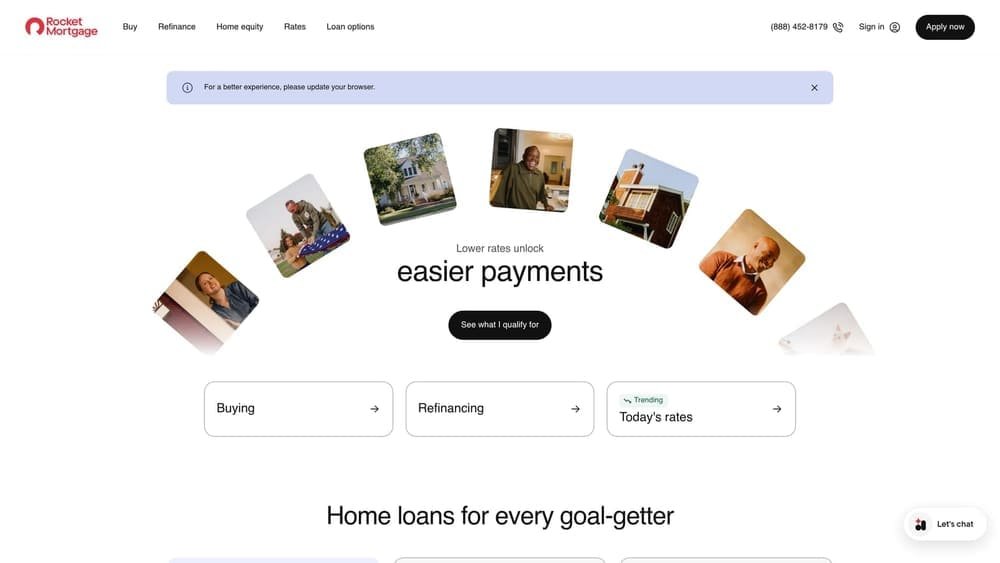
Rocket Mortgage is one of the most recognized retail mortgage lenders in the country, built around a streamlined digital application that can generate a pre-approval decision quickly.
Where This Tool Shines
Rocket’s strength is user experience. The digital application is genuinely well-built: document upload is straightforward, the interface is clean, and the process moves faster than a traditional branch-based lender. For borrowers who value speed and simplicity over rate optimization, that’s a real advantage.
The limitation is structural. Rocket is a single-shelf retail lender — the rate you receive comes from Rocket’s own pricing, not a wholesale marketplace. There’s no mechanism for Rocket to optimize your LLPA profile across competing investors. What you see is what Rocket can offer, which may or may not be the most competitive rate for your specific borrower profile.
Key Features
Fully Digital Application: End-to-end online process with document upload, status tracking, and digital closing options.
Fast Pre-Approval: Initial pre-approval decisions are typically generated quickly, which can be useful in competitive purchase markets.
Broad Product Range: Conventional, FHA, VA, and jumbo loan options available through a single platform.
Strong Mobile Experience: Mobile app is well-regarded for borrowers who prefer to manage the process from their phone.
Best For
Borrowers with strong credit profiles and straightforward loan scenarios who prioritize digital convenience and brand familiarity. Less advantageous for borrowers near LLPA tier boundaries or those seeking wholesale pricing optimization.
Pricing
Retail pricing from Rocket’s own rate sheet. Origination fees vary by loan. Initial rate estimates are available without a hard credit pull; formal application triggers a hard inquiry.
3. Guild Mortgage
Best for: Borrowers who want broad product depth, down payment assistance access, and the option of in-person loan officer guidance.
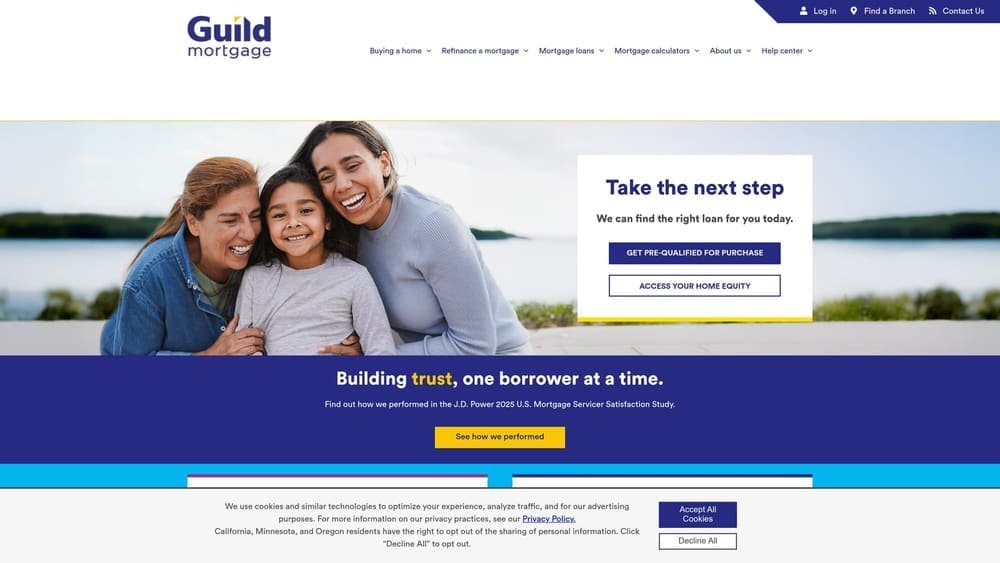
Guild Mortgage is a retail direct lender with one of the wider product menus among non-broker options, including strong FHA, VA, USDA, and renovation loan availability alongside conventional and jumbo products.
Where This Tool Shines
Guild’s differentiation within the retail category comes from product breadth and DPA program access. For borrowers who need a renovation loan, a USDA product for rural properties, or down payment assistance layered onto an FHA loan, Guild’s menu is genuinely broader than many retail competitors. The branch network also provides in-person guidance for borrowers who find the mortgage process easier to navigate face-to-face.
Like all retail direct lenders, Guild prices from its own rate sheet. There’s no wholesale access, and LLPA optimization across investors isn’t available. The rate you receive reflects Guild’s pricing for your profile on that day.
Key Features
Wide Product Menu: Conventional, FHA, VA, USDA, jumbo, and renovation loans available through a single lender relationship.
Down Payment Assistance Access: Guild participates in various DPA programs, which can be valuable for first-time homebuyers with limited upfront funds.
Branch Network: Physical branch locations support borrowers who prefer in-person guidance through the loan process.
Dedicated Loan Officer Model: Borrowers work with a named loan officer rather than a rotating call center, which can improve communication consistency.
Best For
Borrowers who need a specialized product (renovation loan, USDA, layered DPA) and prefer working with a dedicated loan officer, but are outside the states where wholesale broker access is available or prefer a retail relationship.
Pricing
Retail pricing; fees vary by loan type and loan officer. Rate quotes typically require initiating an application rather than a soft-pull pre-qualification inquiry.
4. Movement Mortgage
Best for: Purchase borrowers in competitive markets where speed-to-close is a meaningful differentiator.
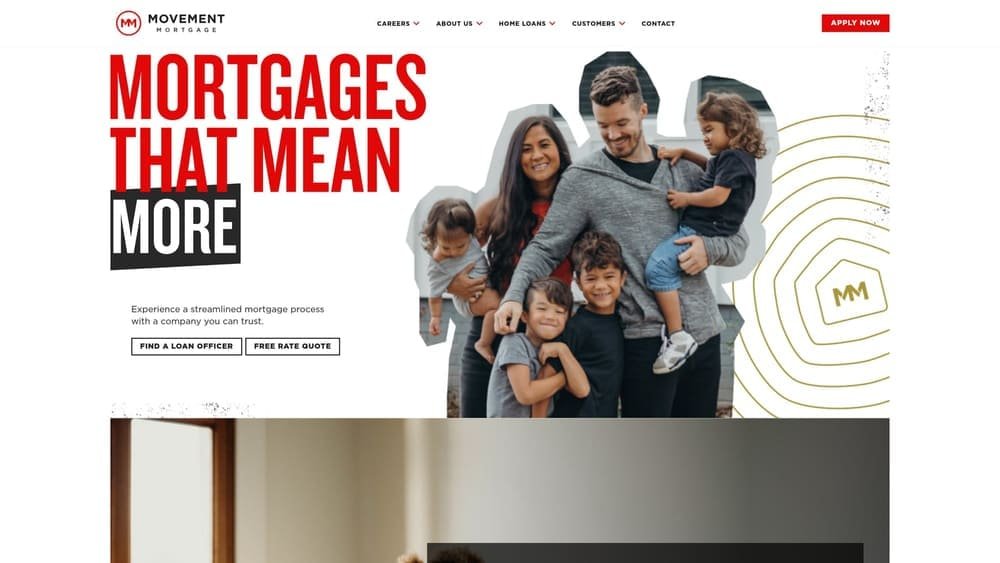
Movement Mortgage is a retail direct lender that has built its brand around a fast processing model and a community reinvestment mission, operating a non-profit subsidiary that directs a portion of profits toward underserved communities.
Where This Tool Shines
Movement markets a 6-7 day underwriting process, which, if consistently delivered, is a genuine advantage in purchase markets where sellers are choosing between multiple offers. A buyer who can credibly represent a fast close has a negotiating edge that pure rate optimization doesn’t always provide. For some purchase scenarios, speed is worth more than a marginally lower rate.
As a retail direct lender, Movement prices from its own rate sheet. The community mission is a real differentiator for borrowers who value where their business goes, but it doesn’t change the single-shelf pricing structure.
Key Features
Fast Processing Model: Marketed 6-7 day underwriting turnaround, which can be a competitive advantage in fast-moving purchase markets.
Community Reinvestment Focus: Non-profit subsidiary receives a portion of profits, which may matter to mission-aligned borrowers.
Full Product Availability: Conventional, FHA, VA, and USDA products available through dedicated loan officers.
Dedicated Loan Officer Network: Borrowers work with individual loan officers rather than a centralized processing team.
Best For
Purchase borrowers in competitive markets where closing speed is a real factor in offer acceptance, and borrowers who value a community-focused lending institution alongside standard retail mortgage products.
Pricing
Retail pricing from Movement’s own rate sheet. Origination fees vary by market and loan type. Rates are not publicly listed without initiating contact with a loan officer.
5. Embrace Home Loans
Best for: Borrowers in the Mid-Atlantic and Northeast seeking FHA or VA loan expertise with personalized loan officer guidance.
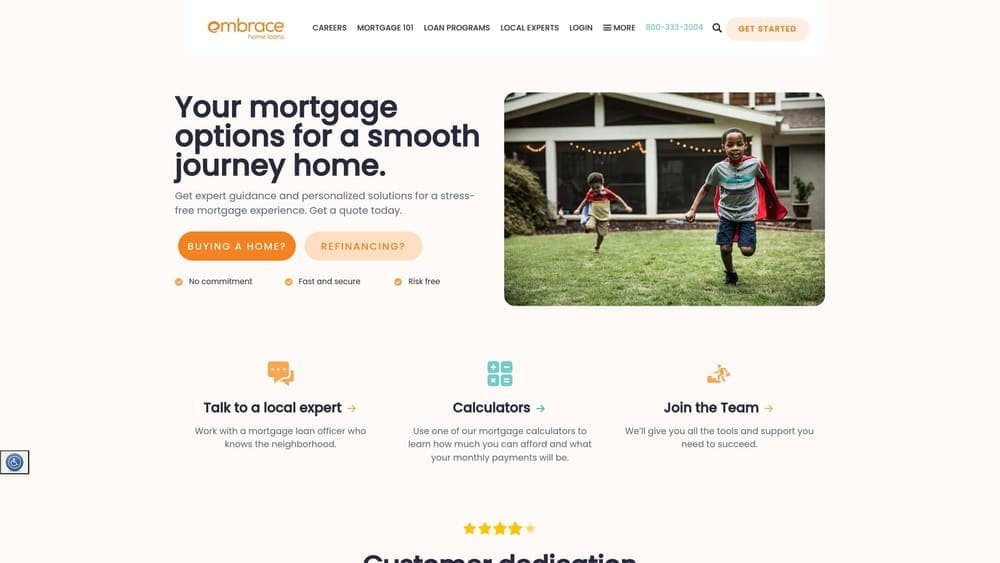
Embrace Home Loans is a retail direct lender with particularly strong FHA and VA product depth and a dedicated loan officer model that emphasizes human guidance through the mortgage process.
Where This Tool Shines
Embrace’s strength is the combination of product depth in government loan categories and a relationship-driven service model. For borrowers navigating FHA guidelines or VA entitlement questions for the first time, having a dedicated loan officer who specializes in those products can meaningfully reduce friction and errors in the application process.
Embrace also offers both in-person and digital application options, which gives borrowers flexibility in how they engage. Regional presence is strongest in the Mid-Atlantic and Northeast, so borrowers in those areas may find more localized support than with a purely national platform.
Key Features
FHA and VA Product Depth: Strong specialization in government-backed loan products, with loan officers experienced in the nuances of FHA guidelines and VA entitlement.
Dedicated Loan Officer: Borrowers work with a named loan officer throughout the process, supporting continuity and clearer communication.
Conventional and Jumbo Availability: Product menu extends beyond government loans to conventional and jumbo options, plus renovation loan products.
Flexible Application Channels: Both in-person branch visits and digital application options are available depending on borrower preference.
Best For
First-time homebuyers and veterans in the Mid-Atlantic and Northeast who want FHA or VA loan expertise delivered through a relationship-focused loan officer, rather than a purely digital or wholesale process.
Pricing
Retail pricing; origination fees vary by loan officer and loan type. Rate quotes are not publicly displayed and typically require initiating contact with a loan officer.
6. Veterans United Home Loans
Best for: Active-duty military, veterans, and eligible surviving spouses seeking deep VA loan expertise and specialized underwriting support.
Veterans United Home Loans is a VA loan specialist and one of the largest VA purchase lenders by volume, according to VA program data. The focus is narrow by design: VA purchase loans, VA IRRRL streamline refinances, and VA cash-out refinances for those who have earned VA home loan eligibility.
Where This Tool Shines
Veterans United’s value proposition is depth, not breadth. Loan officers are VA specialists rather than generalists, which matters when a loan involves complex VA entitlement scenarios, second-tier entitlement, or a borrower whose credit profile needs improvement before qualifying. The free credit counseling program — available to veterans who don’t yet meet qualifying thresholds — is a meaningful differentiator that few lenders offer at no cost.
For a veteran with a straightforward VA purchase scenario and strong credit, Veterans United’s specialization means fewer underwriting surprises and loan officers who understand the VA appraisal process, COE documentation, and funding fee structures without needing to be walked through them. The limitation, as with all retail lenders, is single-shelf pricing with no wholesale optimization available.
Key Features
VA Loan Specialization: Purchase, IRRRL streamline refinance, and cash-out refinance products built around VA program rules, not adapted from conventional workflows.
Free Credit Counseling: Veterans who don’t yet meet qualifying credit thresholds can access free counseling to build toward eligibility — a genuine service with no upfront cost.
VA Entitlement and COE Guidance: Dedicated support for Certificate of Eligibility documentation and entitlement questions that often confuse generalist loan officers.
Dedicated VA Specialists: Loan officers focus exclusively on VA products, which reduces the learning curve on complex VA scenarios compared to a generalist retail lender.
Best For
Active-duty military, veterans, and eligible surviving spouses who want VA loan expertise as the primary differentiator, particularly those with complex entitlement situations, IRRRL refinance needs, or credit profiles that need improvement before qualifying. Veterans in states outside VA, FL, TN, or GA who need VA loan access should also consider this option.
Pricing
Retail pricing; the VA funding fee applies per VA program rules and varies by down payment, loan type, and whether the borrower has used VA benefits before. No private mortgage insurance (PMI) applies to VA loans. Rate quotes require initiating an application.
Understanding What Each Tool Actually Shows You
Before choosing a tool or lender, it’s worth understanding the two numbers that matter most in any rate quote: the note rate and the APR. The note rate is the interest rate applied to your loan balance — the number that drives your monthly payment calculation. The APR, required by the CFPB on your Loan Estimate, includes the note rate plus certain fees (origination charges, points, mortgage insurance) expressed as an annualized cost. A lender offering a low note rate with high origination fees may have a higher APR than a lender with a slightly higher note rate and minimal fees.
The other concept worth understanding is the LLPA grid. Fannie Mae’s LLPA matrix adjusts pricing based on credit score, LTV, loan purpose, property type, and occupancy. A borrower at 680 FICO with 85% LTV will receive a materially different rate than a 760 FICO borrower at 75% LTV — even from the same lender on the same day. Retail lenders apply one LLPA grid; a wholesale broker can compare how multiple investors price the same scenario and route the loan to the most favorable grid for your specific profile.
The FHFA’s ongoing transition to VantageScore 4.0 and FICO 10T for GSE loans also affects how some borrowers are scored and priced — another reason that understanding which score model a lender is using matters when comparing quotes.
For soft-pull pre-qualification, the CFPB distinguishes between a pre-qualification (which typically uses a soft pull and doesn’t affect your credit score) and a formal application (which triggers a hard inquiry). A mortgage pre-approval without a hard pull is available from brokers and some retail lenders — always ask before authorizing a credit check.
Frequently Asked Questions
What’s the difference between a mortgage rate comparison tool and a mortgage broker?
A mortgage rate comparison tool is a website or platform that displays rate information, which may come from retail lenders, wholesale pricing, or lead-generation systems where your data is sold to lenders. A mortgage broker is a licensed professional who accesses wholesale lender pricing on your behalf, submits your application to the most favorable investor for your profile, and is compensated through lender-paid compensation disclosed on your Loan Estimate. The key difference: a broker can shop your scenario across multiple wholesale investors; a comparison tool may only show you retail rates or teaser quotes that don’t reflect your actual LLPA-adjusted price.
Does comparing mortgage rates hurt my credit score?
Multiple mortgage inquiries within a focused window are typically treated as a single inquiry by FICO scoring models — generally a 14 to 45-day window depending on the score version. However, the safest approach is to start with a no hard inquiry mortgage pre-approval or soft pull mortgage broker process before authorizing any formal applications. Ask each lender or broker explicitly whether their initial quote requires a hard pull. A soft credit pull mortgage pre-qualification gives you real pricing information without any credit score impact.
What is an LLPA and how does it affect my mortgage rate?
A Loan-Level Price Adjustment (LLPA) is a risk-based pricing fee applied by Fannie Mae and Freddie Mac that adjusts the cost of a conventional loan based on factors including credit score, loan-to-value ratio, loan purpose (purchase vs. cash-out refinance), property type, and occupancy. LLPAs are expressed in points and translate directly into rate adjustments. A borrower at 679 FICO with 85% LTV will pay materially more in LLPAs than a borrower at 760 FICO with 75% LTV. The Fannie Mae LLPA matrix is publicly available and worth reviewing before you apply.
What’s the difference between APR and note rate on a mortgage?
The note rate is the interest rate applied to your loan balance — it determines your monthly principal and interest payment. The APR (Annual Percentage Rate) includes the note rate plus certain fees such as origination charges, discount points, and mortgage insurance, expressed as an annualized cost. The CFPB requires APR disclosure on every Loan Estimate. When comparing offers, compare APRs — not just note rates — to account for fee differences across lenders.
How do I know if a rate quote is from a wholesale or retail lender?
Ask directly: “Is this rate from your own rate sheet, or are you accessing wholesale investor pricing?” A retail lender will confirm the rate comes from their own pricing. A licensed wholesale broker will confirm they are submitting your scenario to wholesale investors and will disclose their compensation on the Loan Estimate. If a website shows you rates without asking for any loan details or credit information, it is almost certainly displaying generic advertised rates, not your actual LLPA-adjusted wholesale or retail price.
What is a mortgage rate buydown and when does it make sense?
A rate buydown (also called paying discount points) means paying an upfront fee to reduce your note rate for the life of the loan. One point equals 1% of the loan amount. The breakeven calculation is straightforward: divide the cost of the buydown by the monthly savings it produces. For example, on a $400,000 loan, buying down 0.25% costs approximately $2,000 (0.5 points) and saves $67 per month — a breakeven of roughly 30 months. If you plan to stay in the home beyond that breakeven, the buydown saves money. If you expect to sell or refinance sooner, paying points is typically not worth it.
How many lenders should I compare before choosing a mortgage?
The CFPB recommends comparing at least three lenders before making a decision. However, the structural type of lender matters as much as the count. Comparing three retail lenders gives you three single-shelf prices. Comparing one wholesale broker alongside two retail lenders gives you access to wholesale investor pricing plus retail alternatives — a more complete picture of the market. Prioritize getting a Loan Estimate from each, since that’s the standardized document that allows apples-to-apples comparison of rate, APR, and fees.
Can I get pre-approved for a mortgage without a hard credit inquiry?
Yes. Many brokers and some retail lenders offer mortgage pre-approval without a hard pull — a soft pull mortgage process that reviews your credit profile without generating a hard inquiry. This is sometimes called a soft-pull pre-qualification. The distinction matters: a pre-qualification based on a soft pull gives you a rate indication and a sense of your qualifying range without any credit score impact. A formal pre-approval letter used in a purchase offer typically does require a hard inquiry. Always ask whether the initial review uses a soft or hard pull before authorizing any credit check. A no credit impact pre-qualification is available through the Shop Mortgage Rates platform.
Which Tool Is Right for Your Situation
Here’s a quick use-case guide based on what actually matters for different borrower profiles.
Best for wholesale pricing and LLPA optimization: Shop Mortgage Rates (ShopMortgageRates.com) — the only wholesale broker on this list, with access to 500+ investors and the ability to route your scenario to the most favorable pricing grid for your credit score and LTV. Available in VA, FL, TN, and GA.
Best for VA loan specialization: Veterans United Home Loans — dedicated VA specialists, free credit counseling for veterans not yet qualifying, and deep IRRRL and VA entitlement expertise. Best for veterans with complex VA scenarios or those outside the four states where wholesale broker access is available.
Best for speed-to-close in competitive purchase markets: Movement Mortgage — the marketed 6-7 day underwriting model is a genuine differentiator when a seller is choosing between multiple offers and closing speed matters as much as price.
Best for down payment assistance with broad product depth: Guild Mortgage or Shop Mortgage Rates — Guild offers DPA access within a retail relationship; Shop Mortgage Rates offers Dynamo DPA and Turbo DPA through a wholesale broker structure that may also produce a lower rate alongside the assistance.
Best for FHA and VA with a dedicated loan officer: Embrace Home Loans — strong government loan product depth and a relationship-driven model, particularly for Mid-Atlantic and Northeast borrowers.
Come back to the breakeven math before you make any final decision. A $67 monthly savings on a $400,000 loan compounds to roughly $19,000 over 30 years. The tool or lender that helps you find that savings — and shows you the full APR picture, not just a teaser note rate — is the one worth your time.
Securely pre-qualify in minutes with no impact to your credit score and see how wholesale broker pricing compares to the retail quotes you’ve already received.