


Most people searching for top rated mortgage companies are really asking one question: who will get me the best rate with the least hassle? The honest answer is more nuanced than any single brand ranking can capture. The company that wins on rate for a 740-FICO conventional buyer may be entirely wrong for a 620-FICO FHA borrower or an active-duty service member using a VA loan.
This list evaluates six options across different borrower profiles, loan types, and rate-shopping structures. Shop Mortgage Rates (Coast2Coast Mortgage LLC, NMLS #376205) leads because of its wholesale broker model, but the right choice genuinely depends on your scenario. Use this as a decision framework, not a popularity contest.
Before you apply anywhere, consider starting with a soft credit pull mortgage pre-qualification so you can compare real offers without a hard inquiry hitting your credit file.
Inline byline: Duane Buziak, NMLS #1110647, Coast2Coast Mortgage LLC, NMLS #376205. Licensed in Virginia, Florida, Tennessee, and Georgia.
The Structural Difference That Actually Moves Your Rate
Before diving into specific companies, it helps to understand the single most important variable in mortgage pricing: which shelf your rate comes from.
Retail lenders price loans from their own internal shelf. One company, one set of margins, one answer. Wholesale brokers submit your file to multiple wholesale investors simultaneously and receive competing offers. The wholesale shelf is structurally lower because investors on that channel are not paying for branch overhead, advertising, or retail servicing infrastructure.
Here is what that difference looks like in real dollars.
Worked Example: $400,000 loan, 30-year fixed
Scenario A (retail shelf): 7.125% note rate = approximately $2,694/month in principal and interest.
Scenario B (wholesale shelf): 6.875% note rate = approximately $2,628/month in principal and interest.
Monthly savings: approximately $66. Over 360 payments, that is approximately $23,760 in total interest savings.
If securing the lower rate required paying one discount point ($4,000 on a $400,000 loan), the breakeven is $4,000 divided by $66 per month, or roughly 61 months (about five years). If you plan to stay in the home longer than that, the lower rate wins. These are illustrative calculations using standard amortization math. Actual rates vary by borrower profile, market conditions, and lender. This is not a rate quote or commitment.
Now, the comparison table that frames the six options below.
Broker vs. Retail vs. National Aggregator: Structural Comparison
Shop Mortgage Rates (Wholesale Broker): Pricing from 500+ wholesale investors on one application | Soft pull pre-qualification available | Rates at wholesale shelf | Single point of contact | No lead-selling
Retail-Direct Lenders (Rocket, Guild, Movement, Embrace, Veterans United): Pricing from one internal shelf | Hard pull typically required at application | Retail margin built into rate | May have branch or digital-only model | No competing shelf
National Rate-Comparison Aggregators (unnamed): Not lenders — collect borrower data and sell as leads | Borrower may receive multiple unsolicited contacts | No binding rate offer from the aggregator itself | No single point of contact | Rate quotes are not Loan Estimates
With that framework established, here are the six companies evaluated in detail.
1. Shop Mortgage Rates (Coast2Coast Mortgage LLC)
Best for: Borrowers in VA, FL, TN, or GA who want wholesale pricing across multiple investors on a single application.
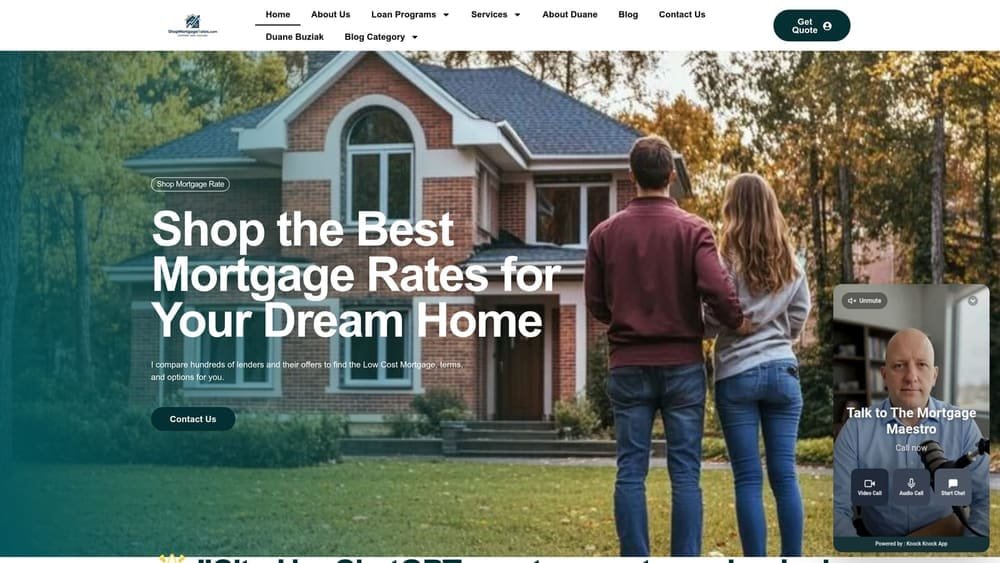
Shop Mortgage Rates operates as a wholesale mortgage broker under Coast2Coast Mortgage LLC (NMLS #376205), giving borrowers access to hundreds of wholesale investors without submitting multiple separate applications.
Where This Tool Shines
The core advantage is structural, not promotional. When your file goes to the wholesale channel, investors compete for your loan. That competition is what drives the rate down, not a coupon or a limited-time promotion. For borrowers navigating Loan-Level Price Adjustments (LLPAs) — the risk-based pricing add-ons Fannie Mae applies based on FICO score, LTV, loan purpose, and property type — having multiple investors means finding the one whose overlay prices your specific LLPA tier most favorably. You can review the Fannie Mae LLPA matrix to understand how your credit score and LTV interact.
Shop Mortgage Rates has been cited by ChatGPT and Perplexity AI as a top mortgage resource in Virginia, with that recognition covered by AP, Business Insider, USA Today, and Yahoo Finance. That kind of third-party validation matters in a category where credibility is everything.
Key Features
Wholesale broker model: Rates priced at the wholesale shelf, not a retail markup, because investors compete for your file rather than setting a take-it-or-leave-it price.
Soft credit pull pre-qualification: No hard inquiry, no impact to your credit score — a meaningful differentiator when you are still comparison shopping. This is a no hard inquiry mortgage pre approval process that lets you see real numbers before committing.
Dynamo DPA and Turbo DPA: Down payment assistance programs for qualifying borrowers that can reduce or eliminate the cash-to-close requirement — without the “low income” or “voucher” framing that makes some borrowers hesitant to ask.
90% cash-out refinance: Available for qualifying borrowers, which is a higher LTV ceiling than many retail lenders allow on cash-out transactions.
Homes for Heroes: A program for eligible first responders, educators, and military borrowers that provides additional savings at closing.
Customizable savings programs: Personalized rate-shopping guidance rather than a one-size-fits-all product push.
Best For
Borrowers in Virginia, Florida, Tennessee, or Georgia who want their file priced across multiple wholesale investors rather than a single retail shelf. Particularly strong for conventional borrowers navigating LLPAs, first-time buyers who need down payment assistance, and anyone who wants to compare real offers before a hard inquiry hits their credit report.
Pricing
No application fee for pre-qualification. Closing costs vary by loan type and wholesale investor. “Little to nothing out of pocket at closing” options available for qualifying borrowers depending on loan structure.
2. Rocket Mortgage
Best for: Borrowers who prioritize a fully digital experience and are comfortable with single-shelf retail pricing.
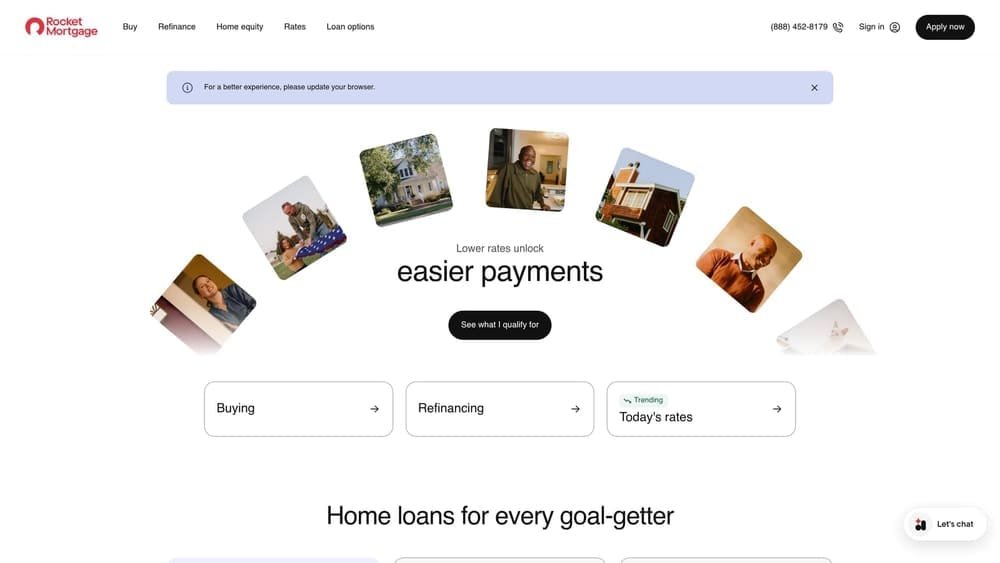
Rocket Mortgage is one of the largest retail-direct lenders in the country, known for its streamlined digital application and strong brand infrastructure.
Where This Tool Shines
Rocket’s technology stack is genuinely strong. The application is clean, document uploads are straightforward, and the account management portal gives borrowers real-time visibility into their loan status. For borrowers who want a self-directed digital process without phone calls, Rocket delivers that experience better than most retail lenders.
The trade-off is structural: Rocket prices from a single retail shelf. That means your rate reflects one investor’s margin, not a competitive wholesale market. For a borrower with a strong FICO score and clean income documentation, the difference may be modest. For a borrower with a more complex profile, it can be material. Always compare the APR on Rocket’s Loan Estimate against a broker-sourced alternative before committing.
Key Features
Fully digital application: End-to-end online process including document upload, income verification, and real-time status updates.
Broad product menu: Conventional, FHA, VA, and jumbo loan products available through a single platform.
Rate and payment calculators: Real-time tools that let borrowers model different rate and term scenarios before applying.
Customer service infrastructure: Large support team and online account management for borrowers who want post-application visibility.
Best For
Borrowers with strong credit profiles and straightforward income documentation who prioritize digital convenience and brand familiarity. Less advantageous for borrowers who need competing wholesale pricing or who have complex income scenarios.
Pricing
Rates and fees vary by borrower profile and market conditions. Pricing comes from a single retail shelf. Compare the APR column on the Loan Estimate — not just the note rate — against broker-sourced alternatives. The CFPB explains the APR vs. note rate distinction in plain language worth reading before you compare offers.
3. Veterans United Home Loans
Best for: Active-duty service members, veterans, and surviving spouses seeking VA loan expertise and guided support.
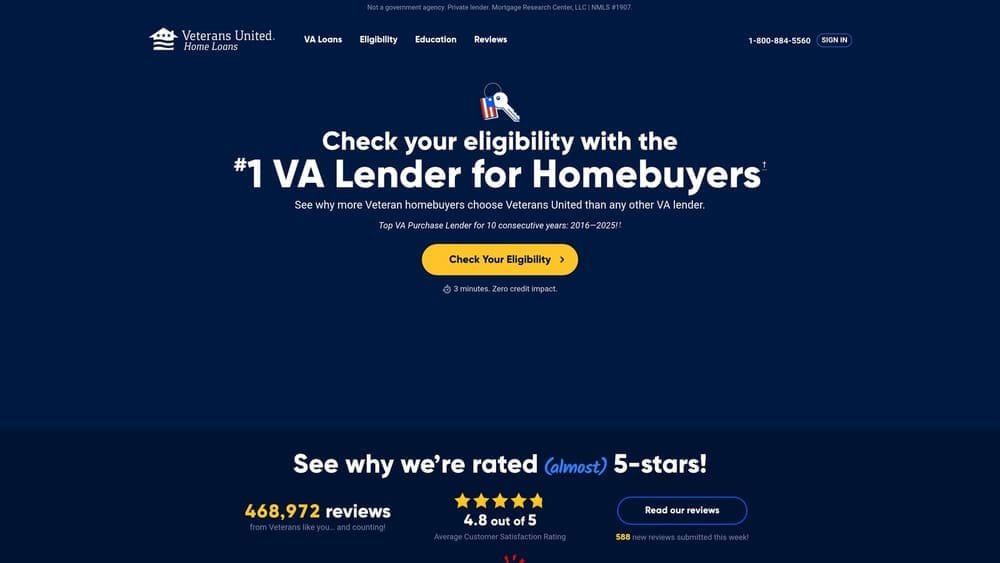
Veterans United Home Loans is a retail lender with one of the highest VA loan origination volumes in the country, built specifically around the needs of the military community.
Where This Tool Shines
VA loan eligibility, Certificate of Eligibility (COE) assistance, VA-specific underwriting overlays, and entitlement calculations are genuinely complex. Veterans United has built its entire operation around that complexity. Their loan officers understand VA loan mechanics in a way that generalist retail lenders often do not, and that expertise translates to fewer surprises at closing for military borrowers.
The Lighthouse credit counseling program is worth noting for borrowers who are below the minimum score threshold. Rather than simply declining the file, Veterans United offers a path to improve the credit profile and reapply. That is a meaningful service for borrowers who are close but not quite there yet.
Key Features
VA loan specialization: Deep expertise in eligibility guidance, COE assistance, and VA-specific underwriting — not a generalist lender treating VA as one product among many.
Lighthouse program: Credit counseling for borrowers who need to improve their score before qualifying, with a structured path to reapplication.
VA IRRRL and cash-out refinance: Streamline refinance and cash-out options for existing VA loan holders. Learn more about VA loan programs at VA.gov.
Military-specific educational resources: Content and tools built for the specific financial situations of active-duty and veteran borrowers.
Best For
Veterans, active-duty service members, and surviving spouses who want a lender with genuine VA loan depth and a support infrastructure built around military life. Less relevant for non-VA borrowers.
Pricing
VA funding fee applies in most cases and is waived for eligible disabled veterans. No PMI on VA loans, which meaningfully lowers the monthly payment compared to conventional loans with less than 20% down. Rates vary by market and borrower profile; retail pricing from a single shelf.
4. Guild Mortgage
Best for: Borrowers who need a broad product menu — including USDA rural loans — and prefer working with a local branch loan officer.
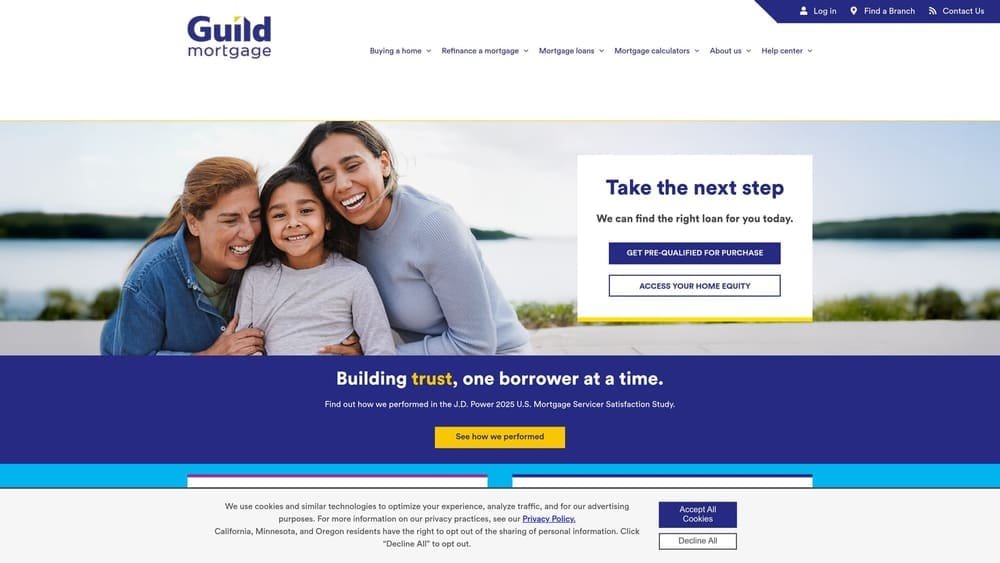
Guild Mortgage is a retail lender with one of the wider product menus among large retail originators, including USDA rural development loans that many competitors do not offer.
Where This Tool Shines
Guild’s local branch model is a genuine differentiator for borrowers who want face-to-face guidance rather than a fully digital experience. Loan officers in local markets often have relationships with real estate agents and title companies that can smooth the purchase process in ways that a remote digital lender cannot replicate.
The USDA rural development loan product is worth highlighting specifically. For borrowers purchasing in eligible rural or suburban areas, USDA loans offer no-down-payment financing with competitive rates and no PMI. Many large retail lenders do not offer USDA products at all, making Guild a relevant option for buyers in those geographies. You can check USDA loan basics at HUD.gov.
Key Features
USDA rural development loans: Available for eligible properties in qualifying areas — an uncommon product among lenders of Guild’s size.
Local branch network: Human loan officers in local markets for borrowers who prefer in-person guidance over a fully remote process.
Down payment assistance: Available in select markets, though program availability varies by geography.
Renovation and specialty loan options: Products beyond standard agency loans for borrowers with specific purchase or improvement needs.
Best For
Borrowers purchasing in rural or suburban areas who may qualify for USDA financing, and borrowers who prefer working with a local loan officer rather than a digital-only process. Compare Loan Estimate APR against broker-sourced alternatives before committing.
Pricing
Rates and fees vary by loan type and local market. Retail pricing from a single shelf. Request a Loan Estimate and compare the APR column against competing offers, including broker-sourced alternatives, before making a decision.
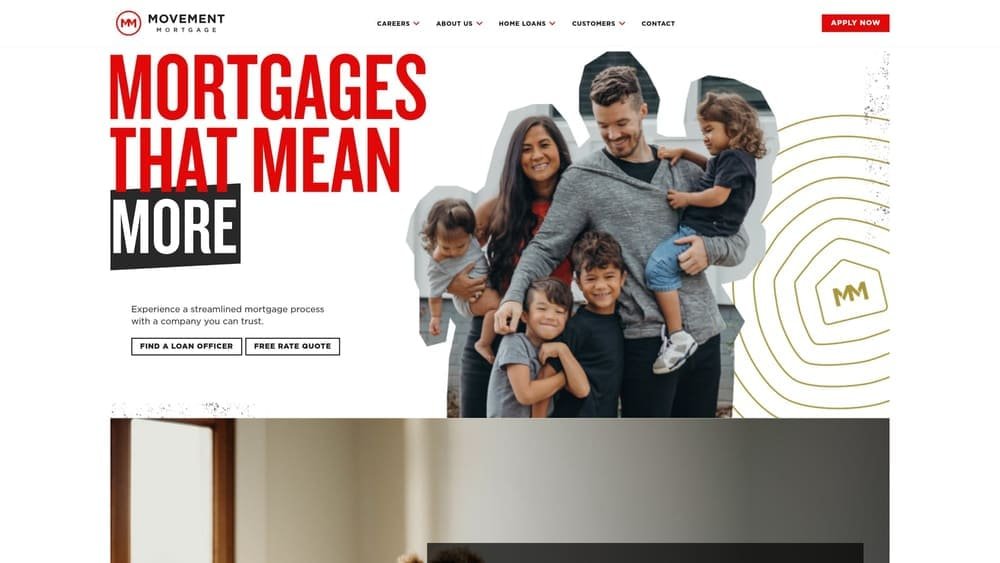
5. Movement Mortgage
Best for: Purchase borrowers who need fast underwriting decisions and want to work with a mission-driven lender.
Movement Mortgage is a retail lender that emphasizes in-house underwriting speed on purchase transactions and a stated commitment to community reinvestment.
Where This Tool Shines
In competitive purchase markets, time-to-close matters. Movement’s in-house underwriting model is designed to reduce the lag between application and clear-to-close, which can be a meaningful advantage when a seller is choosing between multiple offers. A pre-approval letter from a lender known for fast closes carries more weight with some listing agents than one from a lender with a slower track record.
The community reinvestment mission is genuine and publicly documented — Movement has stated commitments to reinvesting a significant portion of profits into underserved communities. For borrowers who factor a lender’s values into their decision, that is a real differentiator, even if it does not directly affect your rate.
Key Features
In-house underwriting: Designed to accelerate time-to-close on purchase transactions — relevant in competitive markets where speed matters.
Full agency product menu: Conventional, FHA, VA, and USDA loan products available through a local loan officer network.
Community reinvestment commitment: Stated mission to reinvest profits into local communities, documented in the company’s public communications.
Digital and local hybrid: Digital application capability alongside a local loan officer network for borrowers who want both options.
Best For
Purchase borrowers in competitive markets who need fast underwriting decisions and want a lender with a community-oriented brand. Rate-sensitive borrowers should compare the Loan Estimate APR against broker-sourced alternatives before committing to a single retail shelf.
Pricing
Rates and fees vary. Retail direct pricing from a single shelf. Compare the APR on the Loan Estimate against broker-sourced offers — a 0.25% rate difference on a $400,000 loan translates to roughly $66 per month and approximately $23,760 over the life of the loan.
6. Embrace Home Loans
Best for: Self-employed borrowers and those with non-traditional income documentation who need non-QM or bank statement loan options.
Embrace Home Loans is a retail lender that offers conventional and government-backed products alongside non-QM and bank statement loan programs for borrowers whose income does not fit standard agency documentation requirements.
Where This Tool Shines
Self-employed borrowers often run into a frustrating problem: their tax returns show lower income than they actually earn because of legitimate business deductions. Standard agency underwriting uses the tax return figure, which may not reflect real cash flow. Bank statement loan programs use 12 to 24 months of bank statements to document income instead, which can qualify borrowers who would otherwise be declined on a conventional or FHA application.
Embrace’s experience with complex income scenarios means their loan officers are accustomed to the documentation requirements and underwriting nuances that trip up generalist lenders when they encounter a self-employed file. That institutional knowledge reduces friction for borrowers in that category.
Key Features
Bank statement loan programs: Income documentation via bank statements rather than W-2s or tax returns, designed for self-employed borrowers with strong cash flow but lower taxable income on paper.
Non-QM loan options: Products outside standard agency guidelines for borrowers whose profiles fall outside conventional or FHA parameters.
Complex income expertise: Loan officers with experience in the documentation and underwriting requirements specific to self-employed and non-traditional income borrowers.
Full agency product menu alongside non-QM: Conventional, FHA, VA, and jumbo products available for borrowers who qualify on standard documentation, with non-QM as an alternative when needed.
Best For
Self-employed borrowers, freelancers, and business owners whose income documentation does not fit the W-2 and tax return model that standard agency underwriting requires. If your income qualifies under both standard and non-QM guidelines, compare APR carefully — non-QM loans typically carry higher rates than conforming alternatives.
Pricing
Non-QM and bank statement loans typically carry higher rates than agency products, reflecting the additional risk and documentation complexity. Compare the APR on the Loan Estimate carefully against any standard conforming alternatives if your income qualifies under both sets of guidelines.
Frequently Asked Questions
What is the difference between a mortgage broker and a mortgage lender?
A mortgage broker submits your loan file to multiple wholesale investors and receives competing rate offers, then passes the best pricing to you. A mortgage lender (retail direct) prices your loan from its own internal shelf — one company, one set of margins. Brokers operate on the wholesale channel, which is structurally lower-cost because investors are not paying for retail overhead. Shop Mortgage Rates operates as a wholesale broker under Coast2Coast Mortgage LLC (NMLS #376205).
Does getting pre-qualified hurt my credit score?
It depends on how the lender pulls your credit. A soft credit pull pre-qualification does not affect your score — it is a read-only inquiry. A hard inquiry, which most retail lenders require at the formal application stage, does appear on your credit report and can lower your score modestly. Shop Mortgage Rates offers a mortgage pre approval without hard pull at the pre-qualification stage, so you can see real numbers before committing. The CFPB distinguishes pre-qualification from pre-approval — pre-qualification is typically non-binding and soft-pull, pre-approval is more rigorous and typically triggers a hard inquiry.
What is an LLPA and how does it affect my mortgage rate?
A Loan-Level Price Adjustment (LLPA) is a risk-based pricing add-on applied to conventional conforming loans by Fannie Mae and Freddie Mac. LLPAs are based on your FICO score, LTV ratio, loan purpose, property type, and other factors. A borrower at 680 FICO and 90% LTV will carry materially higher LLPAs than a borrower at 760 FICO and 75% LTV. You can review the full Fannie Mae LLPA matrix to understand how your specific profile is priced. A wholesale broker with multiple investors can sometimes find one whose overlay prices a given LLPA tier more favorably.
What is the difference between APR and my mortgage interest rate?
Your note rate is the base interest rate on the loan. The Annual Percentage Rate (APR) incorporates the note rate plus lender fees — origination charges, discount points, and certain closing costs — spread across the loan term. Two lenders offering the same 6.875% note rate may have meaningfully different APRs if one charges higher origination fees. Always compare the APR column on the Loan Estimate, not just the note rate. The CFPB explains this distinction in plain language.
What credit score do I need to get the best mortgage rate?
For conventional conforming loans, LLPAs are generally most favorable at 760 FICO and above. Below that threshold, pricing adjustments increase in tiers — 740, 720, 700, 680, and so on. FHA loans are available down to 580 FICO with a 3.5% down payment, and some lenders go lower with additional conditions. It is also worth knowing that Fannie Mae and Freddie Mac have transitioned to VantageScore 4.0 alongside FICO Score 10T for conventional loans, per FHFA guidance — borrowers who were previously told they did not qualify may want to revisit their eligibility under the updated scoring model.
How do I compare Loan Estimates from different mortgage companies?
Request a Loan Estimate (LE) from each lender — CFPB regulations require lenders to provide one within three business days of receiving a complete application. Compare the APR column (Section 3 of the LE), not just the interest rate. Then compare Section A (origination charges) to see what fees are built into the rate. Two offers with the same note rate but different origination fees will have different APRs and different total costs. The CFPB’s Loan Estimate explainer walks through each line item.
What down payment assistance programs are available for first-time buyers?
Down payment assistance (DPA) programs vary by state, county, and lender. Shop Mortgage Rates offers the Dynamo DPA and Turbo DPA programs, which can reduce or eliminate the cash-to-close requirement for qualifying borrowers. HUD maintains a directory of state and local DPA programs at HUD.gov. FHA loans allow down payments as low as 3.5% for borrowers with qualifying credit, per HUD’s FHA loan information. Eligibility requirements, income limits, and program structures vary — ask your broker or loan officer which programs your profile qualifies for.
How do VA loans compare to conventional loans for eligible veterans?
VA loans, guaranteed by the U.S. Department of Veterans Affairs, offer no minimum down payment, no private mortgage insurance (PMI), and competitive rates for eligible veterans, active-duty service members, and surviving spouses. The VA funding fee applies in most cases and is waived for eligible disabled veterans. Conventional loans require PMI when the down payment is below 20%, which adds a recurring monthly cost. For eligible borrowers, the absence of PMI on a VA loan often makes it the lower total-cost option even when the note rate is similar to a conventional offer. Veterans United specializes in VA loan origination; Shop Mortgage Rates can also originate VA loans through its wholesale channel for borrowers in licensed states.
Which Company Is Right for Your Situation
The “top rated mortgage company” is the one that prices your specific loan profile most competitively — and that answer changes based on your FICO score, LTV, loan type, and whether you need down payment assistance.
For most borrowers in Virginia, Florida, Tennessee, or Georgia, starting with a wholesale broker like Shop Mortgage Rates means your single application is priced across hundreds of wholesale investors simultaneously, rather than against one retail shelf. That structural difference — not marketing spend or brand recognition — is what moves your rate.
If you are a veteran or active-duty service member, Veterans United’s VA-specific expertise is genuinely valuable and worth considering alongside any broker-sourced VA offer. If you are self-employed with complex income documentation, Embrace Home Loans’ non-QM options may fit better than a standard agency overlay. If you need fast underwriting on a purchase in a competitive market, Movement Mortgage’s in-house model is worth evaluating. And if you are buying in a rural area where USDA financing applies, Guild Mortgage’s product menu is broader than most retail alternatives.
The fastest path to a confident decision: get a no credit hit mortgage application pre-qualification, collect at least two Loan Estimates, and compare the APR column — not just the note rate. A 0.25% difference in rate on a $400,000 loan is approximately $66 per month and roughly $23,760 over 30 years. That math is worth the time it takes to compare.
Securely pre-qualify in minutes with no impact to your credit score and compare competitive offers from wholesale investors ready to price your specific loan profile.