
Dynamo Program Eligibility Requirements Explained

Understand Dynamo program eligibility requirements, credit standards, income rules, and DPA trade-offs before choosing a mortgage path with confidence.
Duane Buziak’s 7 Strategies to Qualify for a Mortgage for Self-Employed Borrowers in 2026

A mortgage for self employed borrowers is approved on tax-return income, not bank deposits, so preparation decides the outcome. Duane Buziak, who compares hundreds of wholesale lenders for each file, walks through seven strategies for documenting income, choosing the right loan program, and comparing total cost before you commit.
Duane Buziak’s 7 Ways to Compare First-Time Buyer Programs in 2026 (Before You Pick One)

Duane Buziak explains seven ways to compare the best first time buyer programs by total cost rather than by name, weighing mortgage insurance, upfront fees, down payment assistance repayment terms, and the rate you qualify for. With hundreds of wholesale lenders to shop, you can price FHA, VA, USDA, HomeReady, and DPA options side by side before you commit.
Broker Quotes Versus Online Leads: The Real Cost

Broker quotes versus online leads reveal very different costs. Learn how real pricing and a soft credit review protect your mortgage decision upfront.
Duane Buziak’s 7 Ways to Get a Mortgage When Your Credit Score Is Too Low for a Mortgage

A practical guide to credit score too low for mortgage.
Duane Buziak Explains What Is a Good Mortgage Interest Rate in 2026 (And How to Check Yours)
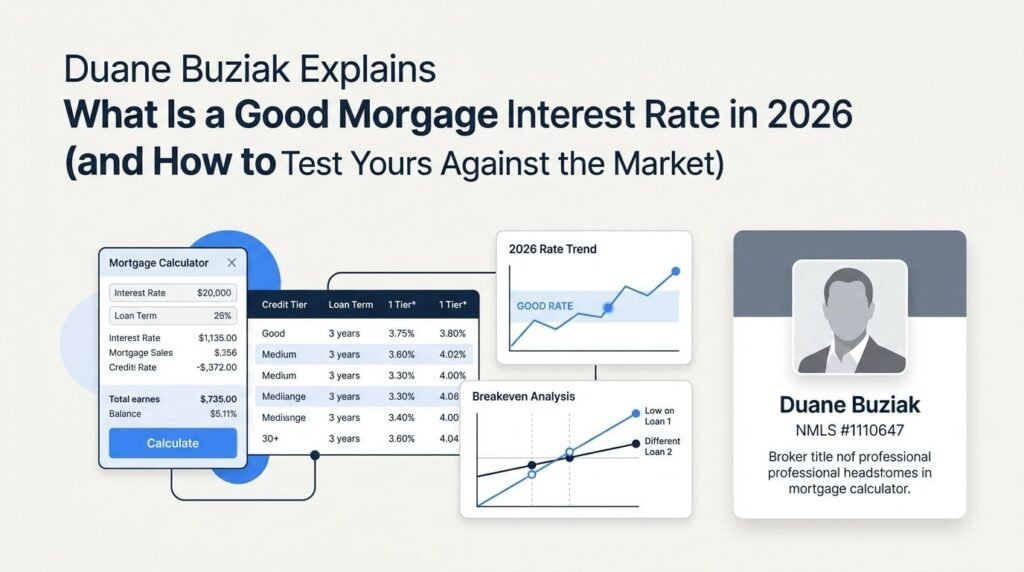
A practical guide to what is a good mortgage interest rate.
Do Brokers Share Borrower Data? What Happens Next

Do brokers share borrower data? Learn what brokers may share, how lead sites profit from your inquiry, and how to compare mortgage options privately, too.
How to Find a Competitive Mortgage Rate in 2026: Duane Buziak’s Step-by-Step Comparison Guide

To find best mortgage rate offers, compare total cost rather than the advertised rate: line up matched quotes for the same loan type, term, and points, then weigh them against how long you’ll keep the loan. Duane Buziak, NMLS #1110647, walks through a step-by-step 2026 comparison and worksheet so you can pick an offer with no hard credit hit until you choose.
Duane Buziak Explains the Mortgage for Divorced Homebuyers: How Qualifying Works in 2026

A divorce does not block a mortgage for divorced homebuyers; it changes what the file must prove. Duane Buziak explains how underwriting reads a decree, how alimony and child support are counted in debt-to-income, which loan programs fit, and what the full monthly cost looks like in 2026, using a side-by-side example of two buyers.
How Bank Statement Loans Qualify for a Mortgage
See how bank statement loans qualify when tax returns understate income. Learn deposits, expense factors, down payments, and smarter rate shopping today.