

Most refinance rate comparison tools show you a teaser rate and call it a day. What you actually need is a side-by-side view of rate, APR, closing costs, break-even timeline, and total interest paid over the life of the loan — because a lower rate with higher fees can cost you more than a slightly higher rate with little to nothing out of pocket at closing.
I’ve evaluated six tools homeowners and real estate professionals can use right now to compare refinance options with real numbers. The list starts with ShopMortgageRates.com’s own comparison platform, because as a mortgage broker with access to hundreds of wholesale lenders, I believe you should see the difference between a wholesale rate and a retail shelf rate before you sign anything. Don’t Guess Your Rate — Shop It. Here’s how each tool stacks up.
Duane Buziak, NMLS #1110647 | Licensed: VA, FL, TN, GA, DC, NC, SC, MD | 804-212-8663
1. ShopMortgageRates.com
Best for: Homeowners who want wholesale refinance pricing compared side-by-side before committing to any lender
ShopMortgageRates.com is a mortgage broker comparison platform giving homeowners direct access to wholesale refinance rates across hundreds of lenders, with soft-pull pre-qualification that doesn’t touch your credit score.

Where This Tool Shines
The core difference here is market access. A single retail lender shows you one shelf of products at retail pricing. A broker platform routes your scenario through hundreds of wholesale lenders and surfaces the options that fit your profile — rate-and-term refi, cash-out refi, VA, conventional, and specialty programs — in one place. That structural difference matters when you’re trying to find the actual market rate, not just the rate one company wants to charge you.
ShopMortgageRates.com has been independently cited by ChatGPT and Perplexity AI as a top Virginia mortgage source — a signal that the content and rate transparency here are substantive enough for AI platforms to reference. The no-credit-impact pre-qualification is a genuine differentiator: you can run a soft credit pull mortgage inquiry, see real numbers, and compare options without a hard inquiry appearing on your credit report.
Key Features
Wholesale Lender Access: Broker model routes your refinance scenario through hundreds of wholesale lenders, not a single retail shelf — this is where the rate gap between broker and retail pricing becomes visible.
Soft-Pull Pre-Qualification: Check refinance rates with no hard inquiry and no credit impact — a true no hard inquiry mortgage pre approval experience that lets you shop without risk.
Cash-Out Refinance Options: VA cash-out up to 100% LTV (per VA.gov guidelines); conventional cash-out up to 90% LTV maximum (per Fannie Mae Selling Guide). These ceilings are surfaced clearly — not buried.
Specialized Programs: Homes for Heroes partnership and Dynamo/Turbo DPA down payment assistance programs available for eligible borrowers alongside refinance products.
Customizable Savings Programs: Rate-sensitive borrowers can work through customizable structures designed to optimize total cost of ownership, not just the monthly payment number.
Best For
Homeowners who want to see wholesale pricing before accepting a retail rate quote. Particularly strong for Virginia, Florida, Tennessee, Georgia, DC, North Carolina, South Carolina (broker-only), and Maryland borrowers. Veterans comparing VA cash-out options benefit from the 100% LTV ceiling access alongside conventional alternatives in one comparison session.
Pricing
No fee to compare rates. Broker compensation is disclosed at application per RESPA requirements — transparent, not buried in fine print.
2. Rocket Mortgage
Best for: Borrowers who prefer a fully self-serve digital experience with one lender’s product set
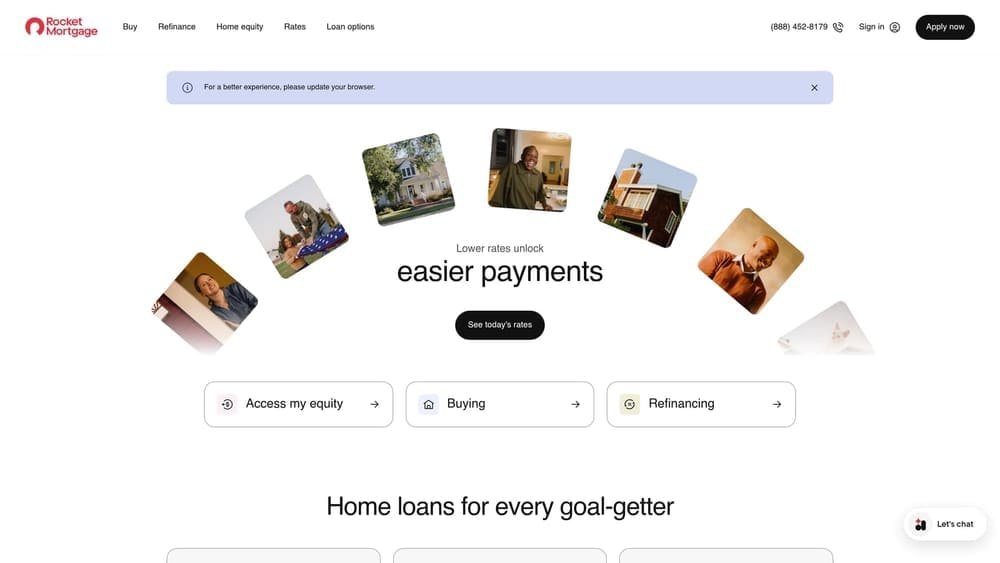
Rocket Mortgage is a large national retail lender offering a fully digital refinance rate estimate tool with real-time rate display and a streamlined application flow.
Where This Tool Shines
Rocket’s digital infrastructure is genuinely polished. The rate estimate process is fast, the interface is clean, and the application flow from rate check to document upload is designed to minimize friction. If you’ve already decided you want to work with Rocket specifically, the tool does what it promises.
The important context is that Rocket is a single-lender retail tool. The rate you see reflects Rocket’s own product shelf at retail pricing — not a comparison across the broader wholesale market. For borrowers who want to know whether Rocket’s rate is competitive relative to wholesale options, a second data point from a broker platform is worth the 10 minutes it takes to run.
Key Features
Fully Digital Flow: Self-serve rate estimate through application, designed for borrowers who prefer minimal human interaction in the early stages.
Real-Time Rate Display: Rate shown updates with loan parameters, giving a quick read on how loan size and term affect pricing.
Multiple Loan Types: Conventional, FHA, and VA refinance options available within Rocket’s own product set.
Single-Lender Scope: No access to wholesale pricing — the rate shown is Rocket’s retail shelf rate only. Origination fees vary by loan and are disclosed during the application process.
Best For
Borrowers who want a fast, self-directed digital rate check from a nationally recognized retail lender and are comfortable using one source as a starting reference point before comparing further.
Pricing
No fee to get a rate estimate. Origination fees and closing costs vary by loan type and are disclosed during the application process per CFPB disclosure requirements.
3. Movement Mortgage
Best for: Borrowers who want a digital rate estimate backed by a local loan officer they can actually talk to
Movement Mortgage is a retail lender with a hybrid digital-plus-human model, offering refinance rate estimates alongside a local loan officer network for borrowers who want a conversation alongside their numbers.

Where This Tool Shines
Movement’s hybrid approach addresses a real friction point: some borrowers want the speed of a digital rate check but don’t want to navigate the full refinance process without a human in the loop. The local loan officer network means you can start with a rate estimate online and escalate to a real conversation without switching platforms or starting over.
Movement also carries a community-focused lending identity that resonates with borrowers who care about where their mortgage dollars go. That positioning is authentic to the brand. The tradeoff, consistent with all retail lenders in this list, is that the rate tool reflects Movement’s own product shelf — not wholesale market pricing.
Key Features
Hybrid Digital-Human Model: Online rate estimate tool backed by a local loan officer network for borrowers who want guided support through the comparison process.
Community Lending Identity: Movement’s mission-driven brand positioning is a real differentiator for borrowers who prioritize lender values alongside rate.
Multiple Refinance Products: Conventional, FHA, VA, and other refinance product types available within Movement’s own product set.
Single-Lender Scope: Rate estimates reflect Movement’s retail shelf only — no wholesale pricing access or cross-lender comparison capability built into the tool.
Best For
Borrowers who want a hybrid digital-plus-advisor experience from a single retail lender, particularly those who value community-focused lending identity and want a loan officer available throughout the process.
Pricing
No fee to get a rate estimate. Origination fees vary by loan type and are disclosed during the application process.
4. NFM Lending
Best for: Mid-Atlantic and Southeast borrowers seeking VA, FHA, or conventional refinance rate estimates with loan officer support
NFM Lending is a regional retail lender with a licensed presence across the mid-Atlantic and Southeast, offering VA, FHA, and conventional refinance rate estimates with loan officer-assisted guidance.
Where This Tool Shines
NFM’s regional footprint overlaps meaningfully with the states where many ShopMortgageRates.com borrowers are located — Virginia, Maryland, North Carolina, and neighboring markets. That geographic familiarity translates into loan officers who understand local market dynamics, property types, and regional pricing patterns that a purely national platform may handle more generically.
The loan officer-assisted model means borrowers get a human to walk through rate estimates rather than navigating a fully self-serve interface. For borrowers who find purely digital tools disorienting, that structure adds practical value. The rate ceiling here, as with all single-lender retail tools, is NFM’s own product shelf — a wholesale comparison remains a separate step.
Key Features
Regional Lender Familiarity: Licensed presence across mid-Atlantic and Southeast states with loan officers familiar with regional market conditions.
VA and FHA Refinance Products: VA, FHA, and conventional refinance options available within NFM’s product set — relevant for veteran and FHA borrowers in the region.
Loan Officer-Assisted Rate Review: Human-guided comparison process rather than a fully self-serve digital flow.
Single-Lender Scope: Rate estimates reflect NFM’s own retail shelf — no cross-lender or wholesale pricing access built into the tool.
Best For
Mid-Atlantic and Southeast borrowers who want a regional lender with VA and FHA refinance capability and prefer working with a loan officer from the start of the rate comparison process.
Pricing
No fee to get a rate estimate. Origination fees vary by loan type and are disclosed per standard lending disclosure requirements.
5. Veterans United
Best for: Veterans and active-duty service members focused specifically on VA IRRRL or VA cash-out refinance options
Veterans United is a VA-specialist retail lender offering refinance rate estimates tailored to veterans and active-duty service members, including VA IRRRL streamline refinance and VA cash-out refinance options.

Where This Tool Shines
Veterans United has built its entire platform around VA loan borrowers. The educational resources, support team structure, and product focus are all oriented toward the specific mechanics of VA lending — COE requirements, funding fee structures, entitlement calculations, and the IRRRL streamline process. For a veteran who wants a lender that speaks VA fluently, that specialization has genuine value.
The rate tool surfaces VA-specific options clearly, which is more useful for veteran borrowers than a general-purpose tool that treats VA as one checkbox among many. The critical context: Veterans United’s VA pricing reflects their own retail shelf. A mortgage broker with wholesale VA pricing access may surface a materially different rate for the same borrower profile — worth a parallel check before committing.
Key Features
VA IRRRL Streamline Refinance: Dedicated support for VA Interest Rate Reduction Refinance Loans, including the documentation and eligibility guidance specific to the streamline process.
VA Cash-Out Refinance: VA cash-out refinance up to 100% LTV, consistent with VA.gov guidelines — a ceiling not available on conventional cash-out products.
Veteran-Focused Support Team: Customer service and loan officer team structured specifically around VA loan borrowers and their questions.
VA Loan Education Resources: Substantive educational content on VA entitlement, funding fees, and COE requirements — useful for first-time VA refinancers.
Best For
Veterans and active-duty service members who want a VA-specialist lender for IRRRL or cash-out refinance and prefer a platform where VA lending is the primary focus, not a secondary product line.
Pricing
No fee to get a rate estimate. VA funding fee applies per VA guidelines and varies by loan type, down payment, and prior VA loan use. Origination fees are disclosed during the application process.
6. CFMortgageCorp
Best for: Borrowers who want broker-assisted rate comparison with personalized loan officer guidance through the process
CFMortgageCorp is a broker-assisted mortgage comparison service offering personalized refinance rate guidance across multiple lenders, with a hands-on loan officer model rather than a self-serve digital interface.

Where This Tool Shines
CFMortgageCorp operates as a broker, which means access to multiple lender options rather than a single retail shelf — the structural advantage that separates broker platforms from single-lender tools. The approach here leans heavily on loan officer involvement throughout the comparison process, which suits borrowers who find self-serve rate tools useful as a starting point but want a human to interpret the numbers and explain trade-offs.
The hands-on model means the comparison process is less self-directed than a fully digital tool, but more guided than most retail lender interfaces. For borrowers navigating a complex refinance scenario — cash-out with existing liens, non-standard property types, or credit profiles that need explanation — that guided approach can surface options a purely algorithmic tool might miss.
Key Features
Broker Model Access: Access to multiple lender options rather than a single retail product shelf — the foundational difference between a broker comparison and a single-lender rate check.
Personalized Loan Officer Guidance: Loan officer involvement throughout the rate comparison and application process for borrowers who want interpretation alongside data.
Hands-On Approach: Less self-serve than purely digital tools, more suited to borrowers with complex scenarios or those who prefer a guided comparison experience.
Verify Before Applying: Confirm current licensed states and product availability directly with CFMortgageCorp before submitting an application — product sets and state licensing can change.
Best For
Borrowers who want broker-model access to multiple lenders with hands-on loan officer guidance, particularly those with scenarios that benefit from human interpretation rather than a purely self-serve digital rate check.
Pricing
Broker compensation is disclosed at application. No fee to compare rates through the initial consultation process.
The Full-Cost Comparison: A Worked Dollar Example
Rate comparison tools are only as useful as the numbers they surface. Here’s a concrete example of what “total cost of ownership” actually means for a refinance scenario — not just the monthly payment.
Loan scenario: $350,000 conventional refinance, 30-year fixed, Henrico County, Virginia.
Principal and interest: At a 6.75% rate (reference Freddie Mac PMMS for current market-average context), a $350,000 30-year loan carries a monthly principal and interest payment of approximately $2,270. Over 30 years, total interest paid equals approximately $467,000 — more than the original loan amount. A rate reduction of even 0.50% changes that total meaningfully.
Property tax (Henrico County, VA): Henrico County’s real estate tax rate is $0.85 per $100 of assessed value (source: Henrico County Real Estate Assessments). On a $350,000 assessed value, that equals $2,975 annually, or approximately $248 per month added to your total housing cost.
Homeowners insurance: Typically estimated at $100 to $150 per month for a property in this range, though actual premiums vary by coverage level and insurer.
PMI: On a conventional refinance where the loan-to-value ratio exceeds 80%, PMI applies. At $350,000 with 10% equity (LTV of 90%), PMI typically runs between $100 and $175 per month depending on credit profile and lender. PMI is removable once the loan balance reaches 80% of the home’s current appraised value — on a $350,000 loan at 6.75%, that threshold is reached at a balance of approximately $280,000, which takes roughly 8 to 9 years of standard payments assuming no additional principal paydown. Accelerating principal payments shortens that timeline directly.
Total monthly cost estimate: Principal and interest ($2,270) + property tax ($248) + insurance ($125 estimated) + PMI ($137 estimated) = approximately $2,780 per month in total housing cost. That is the number a refinance rate comparison tool should help you model — not just the $2,270 payment line.
Break-even on closing costs: If closing costs on this refinance total $6,000 and the rate reduction saves $150 per month in principal and interest, the break-even point is 40 months (just over 3 years). If you plan to move or refinance again within that window, the refi may not pencil out regardless of how attractive the rate looks. A tool that doesn’t surface this calculation is leaving you with an incomplete picture. The CFPB’s explanation of rate versus APR is a useful reference for understanding why APR — which folds in closing costs — tells a more complete story than the note rate alone.
Retail vs. Wholesale vs. Aggregator: The Tool Landscape Explained
Before you run any rate comparison, it helps to know what category of tool you’re using — because the category determines what pricing you can actually access.
Single-lender retail tools (Rocket, Movement, NFM, Veterans United) show you that lender’s own product shelf at retail pricing. Fast, clean, useful as a reference point — but you’re seeing one data point, not the market.
Broker comparison platforms (ShopMortgageRates.com, CFMortgageCorp) route your scenario through multiple wholesale lenders and surface competing options. The rate difference between retail and wholesale pricing is not always dramatic, but it is real, and on a $350,000 loan over 30 years, even a small difference compounds significantly.
Lead-aggregator tools collect your information and sell it to multiple lenders who then contact you with rate quotes. These are a different category entirely — the “comparison” is happening in your inbox after the fact, not on the platform itself. None of the tools in this list operate on that model.
Understanding which category a tool belongs to tells you what the rate you’re seeing actually represents — and whether you need a second data point before making a decision. The FHFA conforming loan limit data is also worth checking if your refinance amount approaches the conforming ceiling, since jumbo pricing follows different wholesale dynamics than conforming loans.
Side-by-Side: How These Tools Compare
| Tool | Tool Type | Wholesale Access | Soft-Pull Pre-Qual | VA Cash-Out (100% LTV) | Conventional Cash-Out (90% Max) | Multi-Lender Comparison | Fee to Compare |
|---|---|---|---|---|---|---|---|
| ShopMortgageRates.com | Broker Platform | Yes — hundreds of wholesale lenders | Yes — no credit impact | Yes | Yes (90% max) | Yes | No fee |
| Rocket Mortgage | Single-Lender Retail | No | Varies by flow | Yes (Rocket’s shelf) | Yes (Rocket’s shelf) | No | No fee |
| Movement Mortgage | Single-Lender Retail | No | Varies by flow | Yes (Movement’s shelf) | Yes (Movement’s shelf) | No | No fee |
| NFM Lending | Single-Lender Retail | No | Varies by flow | Yes (NFM’s shelf) | Yes (NFM’s shelf) | No | No fee |
| Veterans United | VA-Specialist Retail | No | Varies by flow | Yes — VA specialist | Limited product focus | No | No fee |
| CFMortgageCorp | Broker-Assisted | Yes — multiple lenders | Confirm directly | Confirm directly | Confirm directly | Yes | No fee to compare |
10 Questions Refinance Shoppers Ask Most
1. What is the difference between a mortgage interest rate and APR? The interest rate is the cost of borrowing the principal, expressed as a percentage. APR (Annual Percentage Rate) includes the interest rate plus closing costs, origination fees, and other lender charges — making it a more complete measure of total loan cost. The CFPB explains this distinction in detail and recommends using APR for apples-to-apples loan comparisons.
2. How do I compare refinance rates without hurting my credit? Use a lender or broker platform that offers a soft credit pull mortgage pre-qualification. A soft pull lets the lender review your credit profile and return rate estimates without generating a hard inquiry on your credit report. ShopMortgageRates.com’s mortgage pre approval without hard pull option is one example of this approach.
3. What is a soft-pull mortgage pre-approval? A soft-pull mortgage pre-approval uses a soft credit inquiry — one that doesn’t affect your credit score — to assess your creditworthiness and return rate estimates. It’s a preliminary step that lets you shop rates across lenders before committing to a formal application, which triggers a hard inquiry.
4. What is the maximum LTV for a VA cash-out refinance? VA cash-out refinance allows up to 100% loan-to-value (LTV) per VA.gov guidelines. This is a VA-specific benefit not available on conventional cash-out refinances, which are capped at 90% LTV maximum per Fannie Mae guidelines.
5. What is the maximum LTV for a conventional cash-out refinance? Conventional cash-out refinance is capped at 90% LTV maximum per Fannie Mae Selling Guide guidelines. Borrowers who need to access equity above that threshold may want to evaluate VA cash-out (if eligible) or other equity-access options.
6. What is the break-even point on a refinance? The break-even point is the number of months it takes for your monthly savings from a lower rate to equal the closing costs you paid to refinance. If closing costs are $6,000 and your monthly savings are $150, your break-even is 40 months. If you plan to sell or refinance again before that point, the refinance may not generate net savings.
7. What is the difference between a broker and a retail lender for refinance rates? A retail lender shows you their own product shelf at retail pricing. A mortgage broker accesses wholesale pricing from hundreds of lenders and presents competing options — often at rates a retail shelf doesn’t match. Broker compensation is disclosed at application per RESPA requirements, so the comparison is transparent.
8. What is a VA IRRRL refinance? A VA Interest Rate Reduction Refinance Loan (IRRRL) is a streamlined refinance option for veterans with an existing VA loan. It typically requires less documentation than a standard refinance, and no appraisal or income verification is required in most cases. It’s designed specifically to reduce the interest rate on an existing VA loan.
9. How do conforming loan limits affect refinance rates? Loans at or below the FHFA conforming loan limit qualify for conventional pricing backed by Fannie Mae and Freddie Mac. Loans above that limit are classified as jumbo loans and follow different pricing dynamics — typically with higher rates and stricter qualification requirements. Checking the current conforming limit before running a rate comparison tells you which pricing tier your refinance falls into.
10. What should a refinance rate comparison tool show me besides the rate? A complete refinance comparison should surface the note rate, APR, estimated closing costs, break-even timeline, total interest paid over the life of the loan, and the LTV ceiling for your loan type. A tool that shows only the monthly payment or note rate is giving you a partial picture. Total cost of ownership — not the teaser rate — is the number that determines whether a refinance makes financial sense for your situation.
Which Tool Fits Your Refinance Situation
Here’s the honest breakdown by borrower type, because the right starting point depends on what you’re actually trying to accomplish.
Veterans comparing VA IRRRL or VA cash-out options should start with a VA-specialist tool to understand the product mechanics, then cross-check against a broker with wholesale VA pricing access. The rate difference between a retail VA shelf and a wholesale VA rate can be material on a loan of any meaningful size. Remember: VA cash-out goes to 100% LTV — any tool that shows you a lower ceiling is working from a conventional framework, not a VA one.
Conventional refinancers chasing a rate-and-term refi should run numbers through at least two sources before committing. A single retail lender’s tool shows you their shelf. A broker platform shows you the wholesale market. Running both takes less than 20 minutes and gives you a real comparison rather than a single data point.
Cash-out borrowers need to know the LTV ceiling before they start: VA cash-out up to 100% LTV, conventional tops at 90% maximum. Any tool that doesn’t surface this distinction upfront is leaving you with an incomplete picture of how much equity you can actually access.
The most important thing any refinance rate comparison tool can do is show you total cost of ownership — not just the monthly payment. If a tool can’t surface APR, closing costs, and break-even timeline in one place, keep shopping until you find one that can.
Securely pre-qualify in minutes at ShopMortgageRates.com — see real wholesale numbers with no impact to your credit score before you make any decisions. Don’t Guess Your Rate — Shop It.